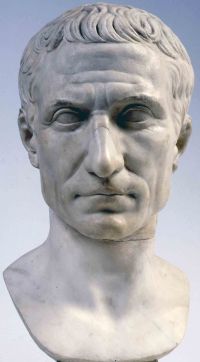
Julius Caesar

Julius Caesar

Summary

Portrait of Julius Caesar Julius Caesar,  Commentaries on the Gallic War (1884)

“ The mode of narration in the Commentaries is so earnest, serious, and straightforward, the logic of events is so closely knit, the words have so strong an appearance of being selected with a view to expressing the simplest truths in the simplest way, that it is only by an effort that we can bring ourselves to criticise the statements which they contain, and examine how far they represent reality. We are never put on our guard, as we often are in reading Livy, Cicero, or Tacitus, by passages whose very eloquence makes us at once suspect concealment of fact. ”
Source: Wikisource

Portrait of Julius Caesar Julius Caesar,  Commentaries on the Gallic War (1884)

“ Indeed, a scholar whose taste is formed upon Caesar's writings does not find anything afterwards in Roman historical writers which pleases him so well. Assuming the view that the Latin language is suited by its inward character to be more than any other the organ of expression for the true and actual, and that it never works with such natural ease as when it is stating facts in the genuine order of their occurrence, one cannot help feeling that Caesar has more nearly than any other writer been able to realise this ideal. ”
Source: Wikisource

Portrait of Julius Caesar Julius Caesar,  Commentaries on the Gallic War (1884)

“ Nothing seems introduced for the sake of antithesis; no colouring, or hardly any, is ever added for the purpose of giving an adventitious interest to the scene; yet a natural euphony and grace pervades the whole. The style easily and naturally sympathises with the most various circumstances of the history; it is forcibly rhetorical in Book I, where the right of the Roman people as against the Helvetii or Ariovistus, as viewed by Caesar, has to be put in the strongest light possible; indeed, in a light stronger than the truth allows. ”
Source: Wikisource

Get perspective with Kwize: daily news enlightened by great literature