“ What the faculty of feeling is to the artist, what the sense of proportion is to the architect, the gift of style is to the writer. Style is the witchery of words; style is clothing thought in captivating language. ”
Style
Definition and stakes
In botany, the style denotes the slender structure that links the ovary to the stigma in flowering plants, acting as a channel for pollen tubes during pollination. Although this structural definition grounds the term in plant morphology, writers have long examined the idea of "style" as a literary and rhetorical element, emphasizing its role in shaping expression. Authors such as Walter Pater and Victor Hugo viewed style as the core of artistic and intellectual uniqueness, praising its ability to captivate, endure, and personalize thought.
Arlo Bates associated style with character, arguing that it exposes a writer’s distinctive voice through word choice and composition, while Frederic Taber Cooper emphasized its varied aspects, spanning from clarity and grace to personal quirks. These viewpoints together highlight style’s dual role as both a biological process and a transformative element in language and literature.
Quotes about “style”
 Walter Pater,
Appreciations, with an Essay on Style
Walter Pater,
Appreciations, with an Essay on Style
“ In that perfect justice, over and above the many contingent and removable beauties with which beautiful style may charm us, but which it can exist without, independent of them yet dexterously availing itself of them, omnipresent in good work, in function at every point, from single epithets to the rhythm of a whole book, lay the specific, indispensable, very intellectual, beauty of literature, the possibility of which constitutes it a fine art. ”
 Victor Hugo,
Medley of Philosophy and Literature
Victor Hugo,
Medley of Philosophy and Literature
“ It is style which insures duration to the work, and fame to the poet. Beauty of expression embellishes beauty of thought, and preserves it; it is at the same time an ornament and armor~ Style, to the idea, is like enamel to the tooth. ”
 Arlo Bates,
Talks on Writing English. First Series
Arlo Bates,
Talks on Writing English. First Series
“ Here we touch upon an important principle which underlies this whole matter. The secret of charm in style lies in character. You have all heard innumerable times the saying that “Style is the man.” In other words, style as a matter of structure in composition is the indication of what a man can do; style as a matter of quality is an indication of what he is.The ways in which individuality shows itself are numerous. Each writer, for instance, may be said to make his own vocabulary. ”
Walter Pater,
Appreciations, with an Essay on Style
“ Even the humorous concluding scenes have traits of special grace, retaining in less emphatic passages a stray lire or word of power, as it seems, so that we watch to the end for the traces where the nobler hand has glanced along, leaving its vestiges, as if accidentally or wastefully, in the rising of the style. ”
 William Wordsworth,
Poems
(1815)
William Wordsworth,
Poems
(1815)
“ Perhaps no where does a more beautiful treatise of the kind exist. The good sense and wisdom of the thoughts, the delicacy of the feelings, and the charm of the style, are, throughout, equally conspicuous. ”
 John Cowper Powys,
Suspended Judgments: Essays on Books and Sensations
John Cowper Powys,
Suspended Judgments: Essays on Books and Sensations
“ The world moves on. Manners, customs, habits, moralities, ideals, all change with changing of the times.Style alone, the imaginative rendering in monumental words of the most personal secrets of our individuality, gives undying interest to what men write. ”
James Augustus St. John, The lives of celebrated travellers… (1832)
“ All that we call purity of taste, vigour of style, and force of thought, has either been taught to the modern world by the study of the classics, or has been guided and restrained by those illustrious models. ”
by Henry James, Italian Hours (1909)
“ As it stretches away before you in that eminent indifference to limits which is at the same time at every step an eminent homage to style, it is altogether too free and fair for compasses and terms. You can only say, and rest upon it, that you prefer it to any other visible fruit of position or claimed empire of the eye that you are anywhere likely to enjoy. ”
Frederic Taber Cooper, The Craftsmanship of Writing (1920)
“ One writer, for instance, assumes that style is a combination of clearness, force and elegance; another looks upon style as a blending of a certain abstract perfection of writing with the personal element, which at best is manner and at worst is mannerism, while still a third considers style as something apart from the personal equation,—a sort of ideal goal towards which we press, but which we never attain. ”
“ You may mark as you please, but don’t violate the commands of Style. I may seem to disappear for a time, when there is a great rush of work, and you may perhaps bring yourself to believe that Style is dead. But do not deceive yourself,—Style never dies. ”
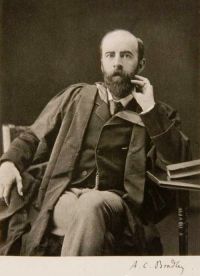 A. C. Bradley,
Poetry for Poetry's Sake
(1901)
A. C. Bradley,
Poetry for Poetry's Sake
(1901)
“ Let us turn to the so-called form—style and versification. There is no such thing as mere form in poetry. All form is expression. Style may have indeed a certain aesthetic worth in partial abstraction from the particular matter it conveys, as in a well-built sentence you may take pleasure in the build almost apart from the meaning. Even then style is expressive—presents to sense, for example, the order, ease, and rapidity with which ideas move in the writer’s mind—but it is not expressive of the meaning of that particular sentence. ”
 Plato,
The Republic of Plato
(1901)
Plato,
The Republic of Plato
(1901)
“ Then beauty of style and harmony and grace and good rhythm depend on simplicity—I mean the true simplicity of a rightly and nobly ordered mind and character, not that other simplicity which is only an euphemism for folly? ”
Earl of Philip Dormer Stanhope Chesterfield, Letters to His Son, Complete
“ Think, therefore, night and day, of the turn, the purity, the correctness, the perspicuity, and the elegance of whatever you speak or write; take my word for it, your labor will not be in vain, but greatly rewarded by the harvest of praise and success which it will bring you. Delicacy of turn, and elegance of style, are ornaments as necessary to common sense, as attentions, address, and fashionable manners, are to common civility ”
Atlantic Classics, Second Series
“ For it is precisely the exact and delicate response to such subtle visitings, whether it be a visiting of fear and dread or of beauty and delight, which, expressing itself in the individual's manner of living and taste for life, we call personality; which, manifesting itself in his art, we call style; which, exhibiting itself in his purpose and action, we call character. ”
“ I could go on naming hosts who have styles distinct by power or affectation, for it is in the style that we show our affectation, as we do it in our walking and our talking; but I would only say that if you wish to be natural and great, think very little upon the style you would take, and more upon the thought you wish to express; be earnest in your work, and by earnestness you will forget your delivery, and so be both natural and original. ”
“ Paine; because I propose to show that the style of the one is the style of the other.Style, by most authors, is treated under the following heads: Perspicuity, Vivacity, and Beauty. Perspicuity, I define, the clear and true expression of our thoughts in the fewest words. Vivacity is the energy or life of expression; it attracts the attention, and excites the imagination. It takes the will by storm and produces conviction. Combined with perspicuity it becomes eloquence. Beauty is the harmony and smoothness of of expression, and is often made synonymous with elegance. ”
 Meredith Nicholson,
Style and the Man
(1911)
Meredith Nicholson,
Style and the Man
(1911)
“ To grasp style much is inevitably presupposed,—grammar, sensibility, taste, a feeling for color and rhythm,—of such things as these is the kingdom of style. In children we often observe an individual and distinctive way of saying things; we all have correspondents whose letters are a joy because of their vivid revelation of the writer. In every community there are persons much quoted for their wit or wisdom, whose sayings have a raciness and tang. ”
 Maria Edgeworth,
The Life and Letters of Maria Edgeworth…
Maria Edgeworth,
The Life and Letters of Maria Edgeworth…
“ Elegance and strength—qualities rarely uniting without injury to each other, combine most perfectly in her style, and this rare combination, added to their classical purity, form, perhaps, the distinguishing characteristics of her writings. ”
Walter Pater,
Appreciations, with an Essay on Style
“ As in living creatures, the blood, nourishing the body, determines its very contour and external aspect, just so, to his mind, the matter, the basis, in a work of art, imposed, necessarily, the unique, the just expression, the measure, the rhythm—the form in all its characteristics. If the style be the man, in all the colour and intensity of a veritable apprehension, it will be in a real sense "impersonal." ”
Anonymous, How to Write a Novel: A Practical Guide to the Art of Fiction
“ In each case language is made the bearer of the writer's personality. Style in literature is the breathing forth of soul and spirit; as is the soul, and as is the spirit in depth, sympathy, and power, so will the style be rich, distinctive, and memorable. Professor Raleigh says that "All style is gesture—the gesture of the mind and of the soul. ”
 William J. Long,
English Literature
William J. Long,
English Literature
“ While it deserves all the adjectives that have been applied to it by enthusiastic admirers,--finished, elegant, splendid, rounded, massive, sonorous, copious, elaborate, ornate, exhaustive,--it must be confessed, though one whispers the confession, that the style sometimes obscures our interest in the narrative. ”
Henry Davenport Northrop, New Century Speaker and Writer… (1901)
“ Nevertheless, I repeat, you should cultivate your own style, not by changing it into some other person’s style, but by striving to preserve its individuality, while decorating it with all the graces of art. Nature gives the style, for your style is yourself; but the decorations are slowly and laboriously acquired by diligent study, and, above all, by long and patient practice. There are but two methods of attaining to this accomplishment—contemplation of the best productions of art, and continuous toil in the exercise of it.Make Your Composition Attractive. ”
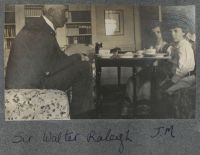 Sir Walter Alexander Raleigh,
Style
Sir Walter Alexander Raleigh,
Style
“ Style, the Latin name for an iron pen, has come to designate the art that handles, with ever fresh vitality and wary alacrity, the fluid elements of speech. By a figure, obvious enough, which yet might serve for an epitome of literary method, the most rigid and simplest of instruments has lent its name to the subtlest and most flexible of arts. Thence the application of the word has been extended to arts other than literature, to the whole range of the activities of man. ”
Samuel R. Wells, How to Behave: A Pocket Manual of Republican Etiquette…
“ Each variety of form, color, and character has its appropriate style; but our space here is too limited to allow us to do more than drop a hint toward what each requires, to produce the most harmonious and effective combination. ”
 Arthur Schopenhauer,
The World as Will and Representation
(1819)
Arthur Schopenhauer,
The World as Will and Representation
(1819)
“ Here, then, as everywhere, the language bears the stamp of the thought from which it has proceeded, for style is the physiognomy of the mind. ”
 John Ruskin,
Modern Painters, Volume 1 (of 5…
John Ruskin,
Modern Painters, Volume 1 (of 5…
“ Now, there is but one grand style, in the treatment of all subjects whatsoever, and that style is based on the perfect knowledge, and consists in the simple, unencumbered rendering, of the specific characters of the given object, be it man, beast, or flower. Every change, caricature, or abandonment of such specific character, is as destructive of grandeur as it is of truth, of beauty as of propriety. ”
Arlo Bates,
Talks on Writing English. First Series
“ The quality which makes intelligible actual statement is Clearness; that which brings home to the reader the wealth of suggestion which may lie behind what is directly said is Force; while beyond both is that quality of style which conveys the intangible, which carries to the mind of the reader emotions too delicate to be confined in words, which touches and arouses as fineness of color or line or sound moves us in painting or sculpture or music. This is what we mean by Elegance. ”
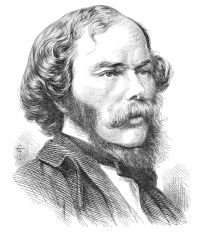 George Henry Lewes,
The Principles of Success in Literature
George Henry Lewes,
The Principles of Success in Literature
“ Endeavour to be faithful, and if there is any beauty in your thought, your style will be beautiful; if there is any real emotion to express, the expression will be moving. ”
Meredith Nicholson,
Style and the Man
(1911)
“ The convenient methods of absent treatment advertised by correspondence schools of authorship are of no avail in the business of style; style can no more be taught than the shadows of clouds across June meadows, or the play of wind over wheat fields can be directed or influenced by the hand of man. ”
 William Graham Sumner,
Folkways
William Graham Sumner,
Folkways
“ In other cases, also, it seems that fashion is pursuing a fleeting and impossible ideal of perfect beauty, style, grace, dexterity, etc., which shall give distinction and superiority or impose subjection. ”
William F. Gekle, Arthur Machen: Weaver of Fantasy (1949)
“ However feelingly and with whatever academic finality this axiom may be delivered—style is obviously more than that, and more than the man. More, too, than words and a certain way of putting them together, and much more than a mere choice of words or dexterity in manipulating them. We have come to think that many of these things do constitute style. ”
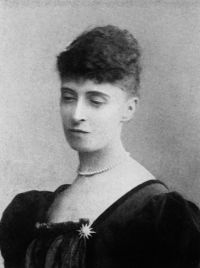 Alice Meynell,
Essays
(1914)
Alice Meynell,
Essays
(1914)
“ For style implies a candour and simplicity of means, an action, a gesture, as it were, in the doing of small things; it is the ignorance of secret ways; whereas the finish of modern life and its neatness seem to be secured by a system of little shufflings and surprises. ”
George French, Printing in Relation to Graphic Art
“ Style is that subtle atmosphere pervading literary, artistic and handicraft work that suggests the cultivated personality of the author. It is not a usual nor a clear conception of style to consider the term as applicable to inferior work. ”
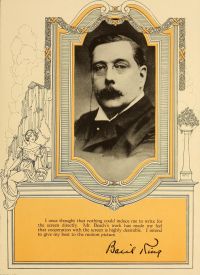 Basil King,
The Street Called Straight
Basil King,
The Street Called Straight
“ He admired the grand style in living, not so much as a matter of display, because presumably it stood for all sorts of mysterious refinements for which he possessed the yearning without the initiation. ”
F. V. N. Painter, Elementary Guide to Literary Criticism
“ As we have just seen, style is affected in a measure by the species of discourse. It is determined, further, by the mental constitution of the writer, and varies according to the dominance of particular faculties. We may distinguish four generic types of mind, which are reflected in four fundamental differences of style. ”
Victor Hugo,
Les Misérables
(1862)
“ Style is the form of the ideal; rhythm is its movement. ”
 Oscar Wilde,
The Soul of Man under Socialism
(1891 | edition)
Oscar Wilde,
The Soul of Man under Socialism
(1891 | edition)
“ From the point of view of style, a healthy work of art is one whose style recognises the beauty of the material it employs, be that material one of words or of bronze, of colour or of ivory, and uses that beauty as a factor in producing the aesthetic effect. ”
W. Y. Sellar, The Roman Poets of the Republic…
“ The style has, in general, the merits of directness and sincerity, often of freshness and vigour, but wants altogether the depth and richness of colour, as well as the finish and moderation which we expect in the literature of a people to whom poetry and art are naturally congenial, and associated with many old memories and feelings. ”
Various, Popular Science Monthly (1910)
“ When we regard the theory of style from the standpoint of recent psychology, a whole series of problems are seen to be involved—the nature of literary genius, association by similarity and its relation to the feelings, and connected with all these—and offering, perhaps, the best point of attack for our present purpose—the functioning of the creative imagination. ”
 Arnold Bennett,
Literary Taste: How to Form It…
(1909)
Arnold Bennett,
Literary Taste: How to Form It…
(1909)
“ Still further to comprehend what style is, let me ask you to think of a writer's style exactly as you would think of the gestures and manners of an acquaintance. You know the man whose demeanour is "always calm," but whose passions are strong. ”
 Vernon Lee,
The Beautiful: An Introduction to Psychological Aesthetics
Vernon Lee,
The Beautiful: An Introduction to Psychological Aesthetics
“ And the more superficial the aesthetic attention given by the beholders, the quicker will style succeed style, and shapes and shape-schemes be done to death by exaggeration or left in the lurch before their maturity ”
Henry Childs Merwin, The Life of Bret Harte, with Some Account of the California Pioneers
“ In fact, it clothes them with that kind and degree of feeling which, as the writer consciously or unconsciously perceives, will best further his intention. Style, in short, is a substitute for speech, the author giving through the medium of his style the same emotional and personal color to his thoughts which the orator conveys by the tone and inflections of his voice. Hence the saying that the style is the man. ”
Various, The Atlantic Monthly, Volume 17…
“ The transformation of style which was visible at the very outset is one of the miracles of literary art. Simplicity, swiftness, precision, all the qualities which were conspicuously absent, we will not say wanting, in the Portraits,—these are the characteristics, and that in a surpassing degree, of the Causeries. ”
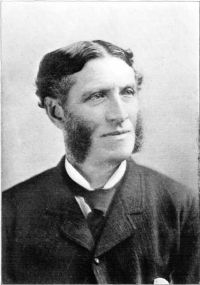 Matthew Arnold,
Selections from the Prose Works of Matthew Arnold
Matthew Arnold,
Selections from the Prose Works of Matthew Arnold
“ Style, in my sense of the word, is a peculiar recasting and heightening, under a certain condition of spiritual excitement, of what a man has to say, in such a manner as to add dignity and distinction to it; ”
 Edward Young,
Young's Night Thoughts
Edward Young,
Young's Night Thoughts
“ Man of the world (for such would’st thou be call’d) ,And art thou proud of that inglorious style? ”
W. Y. Sellar, The Roman Poets of the Republic…
“ Their merits of style, such as the simple force with which they go directly to the heart of a matter, and the grave earnestness of their tone, are qualities characteristic rather of oratory than of poetry. ”
Clayton Meeker Hamilton, Materials and Methods of Fiction
“ Style, in its highest development, belongs only to the finest art of literature; and it must be admitted that literature is not always, nor even perhaps most frequently, a fine art. Of the four rhetorical moods, or methods, of discourse, exposition lends itself the least to the assistance of the quality of style. ”
Related terms
Authors who wrote about “style”
Related articles
The Glass of Fashion, The Tyranny of Style
Fashion is a constant debate: is it a tyrannical force demanding conformity, or a powerful art form for self-expression? Uncover the thinkers who saw clothing as both a superficial delusion and a deep reflection of an era's soul, and how individuality can triumph over arbitrary trends.
Samuel Smiles, Ida M. Tarbell, Oscar Wilde
Handel, Between Universal Acclaim and Critical Scrutiny
George Frideric Handel captivated the masses with his immediate, universal appeal. But his genius for perfecting existing forms, rather than forging new paths, created a complex legacy—a towering figure whose immense success proved both a blessing and a burden, constantly re-evaluated against the intellectual depth of J.S. Bach.
Romain Rolland, John Alexander Fuller Maitland & William Barclay Squire, Daniel Gregory Mason
The perpetual tension: Piety, pomp, and the problem of religious dress
Dress is a battleground where humility and vanity perpetually clash. Historical religious texts offer three competing frameworks: outright condemnation of fashion as worldly corruption, celebration of aesthetic expression as divine mandate, and the perilous ascetic path of plainness.
Harriet Beecher Stowe, G. S. Weaver, Philip Schaff
The poetic tension: Prophet versus fox in literary creation
Great poets inhabit the creative tension between seeking sublime, universal unity (the prophet) and embracing fragmentation, contradiction, and the specific particulars of the human condition (the fox). This dichotomy, rooted in classical criticism, defines enduring literary genius.
Longinus, Samuel Taylor Coleridge, George Santayana
