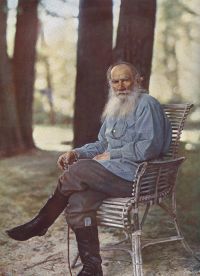
Leo Tolstoy

Leo Tolstoy

Summary

Portrait of Leo Tolstoy Leo Tolstoy War and Peace (1952)

On hearing that he was going to Petersburg Natásha was astounded.
“To Petersburg!” she repeated as if unable to understand.
But noticing the grieved expression on Princess Mary's face she guessed the reason of that sadness and suddenly began to cry.
“Mary,” said she, “tell me what I should do! I am afraid of being bad. Whatever you tell me, I will do. Tell me. . .”
“You love him?”
“Yes,” whispered Natásha.
“Then why are you crying? I am happy for your sake,” said Princess Mary, who because of those tears quite forgave Natásha's joy.
Source: Wikisource

Portrait of Leo Tolstoy Leo Tolstoy War and Peace (1952)

Natásha looked at Sónya with wide-open eyes as if she could not grasp the question.
“Well, then, are you refusing Prince Andrew?” said Sónya.
“Oh, you don't understand anything! Don't talk nonsense, just listen!” said Natásha, with momentary vexation.
“But I can't believe it,” insisted Sónya. “I don't understand. How is it you have loved a man for a whole year and suddenly. . . Why, you have only seen him three times! Natásha, I don't believe you, you're joking! In three days to forget everything and so. . .”
“Three days?” said Natásha. “It seems to me I've loved him a hundred years.
Source: Wikisource

Portrait of Leo Tolstoy Leo Tolstoy War and Peace (1869)

Sometimes he remembered how he had heard that soldiers in war when entrenched under the enemy’s fire, if they have nothing to do, try hard to find some occupation the more easily to bear the danger. To Pierre all men seemed like those soldiers, seeking refuge from life: some in ambition, some in cards, some in framing laws, some in women, some in toys, some in horses, some in politics, some in sport, some in wine, and some in governmental affairs. “Nothing is trivial, and nothing is important, it’s all the same—only to save oneself from it as best one can,” thought Pierre.
Source: Gutenberg

Get perspective with Kwize: daily news enlightened by great literature