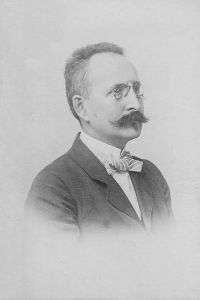
Leonard Jan Józef Lepszy

Leonard Jan Józef Lepszy

Summary

Portrait of Leonard Jan Józef Lepszy Leonard Jan Józef Lepszy Cracow, the royal capital of ancient Poland… (1912)

INTERIOR OF HOLY CROSS CHURCH. Civil Architecture only began in the fourteenth century. The enormous architectural activity of Casimir the Great, as attested by history, proves true the saying of posterity, that he had found a Poland built of wood, and left behind one of brick. Cracow architecture was regulated by a statute for masons, issued in 1367. Although none of the medieval buildings has preserved its original form, yet those that remain show many traces of medieval structure and give us an idea of what profane architecture was like.
Source: Wikisource

Portrait of Leonard Jan Józef Lepszy Leonard Jan Józef Lepszy Cracow, the royal capital of ancient Poland… (1912)

Thus, e.g., the folding altar-piece, dedicated to the Holy Trinity, in the Holy Cross Chapel of the cathedral, exhibiting all the characteristic features of North German Gothicism, is usually assigned to the carver Laurence of Magdeburg, who lived at Cracow. The altar of St. John in St. Florian's Church, of 1518, differs from all the carvings hitherto described; it is evidently the work of an artist more modern in spirit, and desirous to strike out in a new direction: the elegant attitudes of the bodies, the picturesque grouping, the noble lines of the drapery, all usher in a new period.
Source: Wikisource

Portrait of Leonard Jan Józef Lepszy Leonard Jan Józef Lepszy Cracow, the royal capital of ancient Poland… (1912)

They show seven coats-of-arms of the principalities of Poland; among these, the arms of the Dobrzyn country with the expressive head of King Casimir the Great, that of his wife Adelaide of Hesse, and other figures of men as well as of beasts and imaginary symbolical creatures. These works of plastic art are distinguished by subtle intuition of nature and eloquent expression of character; both they and those in the windows of St. Mary's Church prove an intimate knowledge of medieval symbolism on the artist's part, and his close contact with Western art.
Source: Wikisource

Get perspective with Kwize: daily news enlightened by great literature