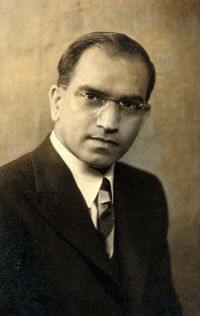
Mandayam Osuri Tirunarayana Iyengar

Mandayam Osuri Tirunarayana Iyengar

Summary

Portrait of Mandayam Osuri Tirunarayana Iyengar Mandayam Osuri Tirunarayana Iyengar A note on grappling tail-hooks in anopheline larvae (1922)

In all these species, the hooks are present quite characteristically.
In a pond, it may be presumed that if the larva were to be disturbed it would be compelled to go to the bottom. But this has never been observed to happen. The larvæ of Anophelines breeding in ponds with a floating vegetation of Pistia stratiotes for instance, get in between the roots of the Pistia when disturbed and hang from the rootlets by their tail-hooks. But sometimes they grip the rootlets with their mandibles. From such positions it is difficult to dislodge them.
Source: Wikisource

Portrait of Mandayam Osuri Tirunarayana Iyengar Mandayam Osuri Tirunarayana Iyengar A note on grappling tail-hooks in anopheline larvae (1922)

But the branches of the median supra-anal tufts have also been found in a few cases to have very minute hooks at their tips, visible only under the high power. They are very small and feeble, and may not be of any great use. I have found them in the larvæ of A. maculipalpis, culicifacies and minimus.
The following are observations of larvæ of Anopheles stephensi breeding in cisterns in Calcutta. When the larva rests along the surface of the water, the hooked setæ are projected backwards and the hooks point downwards (Plates, LXI and LXII, figs. 4-5) .
Source: Wikisource

Get perspective with Kwize: daily news enlightened by great literature