Summary

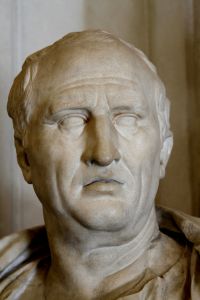
Portrait of Marcus Tullius Cicero Marcus Tullius Cicero Letters to Atticus — 1.13 (XVIII)

Besides, the second place has a dignity almost equal to that of princeps senatus, and does not put one under too much of an obligation to the consul. The third called on was Catulus; the fourth, if you want to go still farther, Hortensius. The consul himself [5] is a man of a small and ill-regulated mind, a mere buffoon of that splenetic kind which raises a laugh even in the absence of wit: it is his face rather than his facetiousness [6] that causes merriment : he takes practically no part in public business, and is quite alienated from the Optimates.
Source: Wikisource

Portrait of Marcus Tullius Cicero Marcus Tullius Cicero Letters to Atticus — 1.13 (XVIII)

Messalla as yet is strongly for severe measures. The loyalists hold aloof owing to the entreaties of Clodius : bands of ruffians are being got together: I myself, at first a stern Lycurgus, am becoming daily less and less keen about it: Cato is hot and eager. In short, I fear that between the indifference of the loyalists and the support of the disloyal it may be the cause of great evils to the Republic.
Source: Wikisource

Portrait of Marcus Tullius Cicero Marcus Tullius Cicero Letters to Atticus — 1.13 (XVIII)

To the speech in answer to Metellus. [10] I have made some additions. The book shall be sent you, since affection for me gives you a taste for rhetoric. What news have I for you? Let me see. Oh, yes! The consul Messalla has bought Antonius's house for 3,400 sestertia. What is that to me? you will say. Why, thus much. The price has convinced people that I made no bad bargain, and they begin to understand that in making a purchase a man may properly use his friends' means to get what suits his position. The Teucris affair drags on, yet I have hopes. Pray settle the business you have in hand.
Source: Wikisource

Get perspective with Kwize: daily news enlightened by great literature