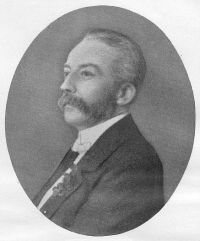
Richard Claverhouse Jebb

Richard Claverhouse Jebb

Summary

Portrait of Richard Claverhouse Jebb Richard Claverhouse Jebb 1911 Encyclopædia Britannica, Volume 17… (1911)

Lysias was a man of kindly and genial nature, warm in friendship, loyal to country, with a keen perception of character. and a fine though strictly controlled sense of humour. The literary tact which is so remarkable in the extant speeches is that of a singularly flexible intelligence, always obedient to an instinct of gracefulness. He owes his distinctive place to the power of concealing his art. It was obviously desirable that a speech written for delivery by a client should be suitable to his age, station and circumstances. Lysias was the first to make this adaptation really artistic.
Source: Wikisource

Portrait of Richard Claverhouse Jebb Richard Claverhouse Jebb 1911 Encyclopædia Britannica, Volume 17… (1911)

In literary and historical interest, the first place among the extant speeches of Lysias belongs to that Against Eratosthenes (403 B.C.) , one of the Thirty Tyrants, whom Lysias arraigns as the murderer of his brother Polemarchus. The speech is an eloquent and vivid picture of the reign of terror which the Thirty established at Athens; the concluding appeal, to both parties among the citizens, is specially powerful.
Source: Wikisource

Portrait of Richard Claverhouse Jebb Richard Claverhouse Jebb 1911 Encyclopædia Britannica, Volume 17… (1911)

LYSIAS, Attic orator, was born, according to Dionysius of Halicarnassus and the author of the life ascribed to Plutarch, in 459 B.C. This date was evidently obtained by reckoning back from the foundation of Thurii (444 B.C.) , since there was a tradition that Lysias had gone thither at the age of fifteen. Modern critics would place his birth later,—between 444 and 436 B.C.,—because, in Plato’s Republic, of which the scene is laid about 430 B.C., Cephalus, the father of Lysias, is among the dramatis personae, and the emigration of Lysias to Thurii was said to have followed his father’s death.
Source: Wikisource

Get perspective with Kwize: daily news enlightened by great literature