Summary

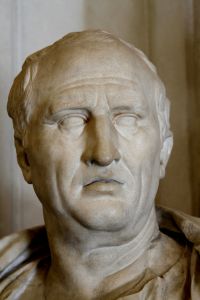
Portrait of Marcus Tullius Cicero Marcus Tullius Cicero Letters to Atticus — 2.7 (XXXIII)

Cicero supposes Pompey and Caesar as intending to act in that capacity. Pompey, it seems, did eventually attend.↑ One of the twenty commissioners under Caesar's agrarian law. Cicero was offered and declined a place among them. The "only man," of course, refers to the intrusion on the mysteries.↑ To Egypt.↑ This seems also to refer to the twenty agrarian commissioners, who, according to Mommsen, were divided into committees of five, and were, therefore, spoken of indifferently as quinqueviri and vigintiviri.
Source: Wikisource

Portrait of Marcus Tullius Cicero Marcus Tullius Cicero Letters to Atticus — 2.7 (XXXIII)

We don't know what mistake is refened to; probably as to some money transmitted to Pomponius.↑ It is suggested that Aristodemus is some teacher of the two young Ciceros, to whom the young Marcus wishes to apologize for his absence or to promise some study.↑ Perhaps some inscription or other ornament for Atticus's gymnasiusn in his villa at Buthrotum.
Source: Wikisource

Portrait of Marcus Tullius Cicero Marcus Tullius Cicero Letters to Atticus — 2.7 (XXXIII)

Terentia sends you her regards: my boy Cicero commissions you to give Aristodemus the same answer for him as you gave for his cousin, your sister's son. [7] I will not neglect your reminder about your Amaltheia. [8] Take care of your health.
Footnotes ↑ As he was a man sui iuris, Clodius's adoption into a new gens (adrogatio) would have to take place before the comitia curiata (now represented by thirty lictors) , which still retained this formal business.
Source: Wikisource

Get perspective with Kwize: daily news enlightened by great literature