Summary

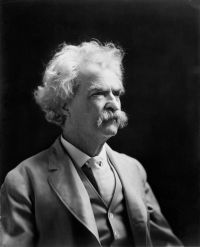
Portrait of Mark Twain Mark Twain Life on the Mississippi, Part 11

WE left for St. Louis in the 'City of Baton Rouge,' on a delightfully hot day, but with the main purpose of my visit but lamely accomplished. I had hoped to hunt up and talk with a hundred steamboatmen, but got so pleasantly involved in the social life of the town that I got nothing more than mere five-minute talks with a couple of dozen of the craft.
I was on the bench of the pilot-house when we backed out and 'straightened up' for the start—the boat pausing for a 'good ready,' in the old-fashioned way, and the black smoke piling out of the chimneys equally in the old-fashioned way.
Source: Gutenberg

Portrait of Mark Twain Mark Twain Life on the Mississippi, Part 11

The people of Hannibal are not more changed than is the town. It is no longer a village; it is a city, with a mayor, and a council, and water-works, and probably a debt. It has fifteen thousand people, is a thriving and energetic place, and is paved like the rest of the west and south—where a well-paved street and a good sidewalk are things so seldom seen, that one doubts them when he does see them.
Source: Gutenberg

Portrait of Mark Twain Mark Twain Life on the Mississippi, Part 11

The carpenter blustered, flourished his knife, and doomed this Lynch in his usual volcanic style, the size of his fateful words undiminished; but it was all wasted upon me; he was a hero to me no longer, but only a poor, foolish, exposed humbug. I was ashamed of him, and ashamed of myself; I took no further interest in him, and never went to his shop any more. He was a heavy loss to me, for he was the greatest hero I had ever known. The fellow must have had some talent
Source: Gutenberg

Get perspective with Kwize: daily news enlightened by great literature