Summary

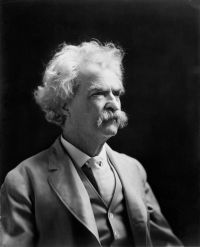
Portrait of Mark Twain Mark Twain Pudd'nhead Wilson — Pudd'nhead Wins His Name (1894)

When there was room on the ledge outside of the pots and boxes for a cat, the cat was there -- in sunny weather -- stretched at full length, asleep and blissful, with her furry belly to the sun and a paw curved over her nose. Then that house was complete, and its contentment and peace were made manifest to the world by this symbol, whose testimony is infallible. A home without a cat -- and a well-fed, well-petted, and properly revered cat -- may be a perfect home, perhaps, but how can it prove title?
Source: Wikisource

Portrait of Mark Twain Mark Twain Pudd'nhead Wilson — Pudd'nhead Wins His Name (1894)

The chief citizen was York Leicester Driscoll, about forty years old, judge of the county court. He was very proud of his old Virginian ancestry, and in his hospitalities and his rather formal and stately manners, he kept up its traditions. He was fine and just and generous. To be a gentleman -- a gentleman without stain or blemish -- was his only religion, and to it he was always faithful. He was respected, esteemed, and beloved by all of the community.
Source: Wikisource

Portrait of Mark Twain Mark Twain Pudd'nhead Wilson — Pudd'nhead Wins His Name (1894)

If he owned one half of the general dog, it would be so; if he owned one end of the dog and another person owned the other end, it would be so, just the same; particularly in the first case, because if you kill one half of a general dog, there ain't any man that can tell whose half it was; but if he owned one end of the dog, maybe he could kill his end of it and -- "
"No, he couldn't either; he couldn't and not be responsible if the other end died, which it would. In my opinion that man ain't in his right mind."
Source: Wikisource

Get perspective with Kwize: daily news enlightened by great literature