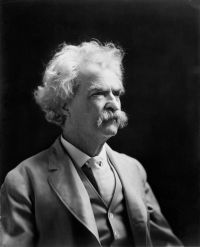
Mark Twain

Mark Twain

Summary

Portrait of Mark Twain Mark Twain Roughing It — Chapter V (1872)

The cayote will go swinging gently off on that deceitful trot of his, and every little while he will smile a fraudful smile over his shoulder that will fill that dog entirely full of encouragement and worldly ambition, and make him lay his head still lower to the ground, and stretch his neck further to the front, and pant more fiercely, and stick his tail out straighter behind, and move his furious legs with a yet wilder frenzy, and leave a broader and broader, and higher and denser cloud of desert sand smoking behind, and marking his long wake across the level plain!
Source: Wikisource

Portrait of Mark Twain Mark Twain Roughing It — Chapter V (1872)

The cayote is a long, slim, sick and sorry-looking skeleton, with a gray wolf-skin stretched over it, a tolerably bushy tail that forever sags down with a despairing expression of forsakenness and misery, a furtive and evil eye, and a long, sharp face, with slightly lifted lip and exposed teeth. He has a general slinking expression all over. The cayote is a living, breathing allegory of Want. He is always hungry.
He is always poor, out of luck and friendless. The meanest creatures despise him, and even the fleas would desert him for a velocipede.
Source: Wikisource

Portrait of Mark Twain Mark Twain Roughing It — Chapter V (1872)

And all this time the dog is only a short twenty feet behind the cayote, and to save the soul of him he cannot understand why it is that he cannot get perceptibly closer; and he begins to get aggravated, and it makes him madder and madder to see how gently the cayote glides along and never pants or sweats or ceases to smile; and he grows still more and more incensed to see how shamefully he has been taken in by an entire stranger, and what an ignoble swindle that long, calm, soft-footed trot is
Source: Wikisource

Get perspective with Kwize: daily news enlightened by great literature