“ The cayote is a long, slim, sick and sorry-looking skeleton, with a gray wolf-skin stretched over it, a tolerably bushy tail that forever sags down with a despairing expression of forsakenness and misery, a furtive and evil eye, and a long, sharp face, with slightly lifted lip and exposed teeth. He has a general slinking expression all over. The cayote is a living, breathing allegory of Want. He is always hungry. He is always poor, out of luck and friendless. The meanest creatures despise him, and even the fleas would desert him for a velocipede. ”
Cayote
Definition and stakes
The theme of “cayote” has been addressed by authors such as Mark Twain and William Henry Giles Kingston. It is often associated with terms like dog, coyote, hunger, sand and want.
Quotes about “cayote”
“ The cayote will go swinging gently off on that deceitful trot of his, and every little while he will smile a fraudful smile over his shoulder that will fill that dog entirely full of encouragement and worldly ambition, and make him lay his head still lower to the ground, and stretch his neck further to the front, and pant more fiercely, and stick his tail out straighter behind, and move his furious legs with a yet wilder frenzy, and leave a broader and broader, and higher and denser cloud of desert sand smoking behind, and marking his long wake across the level plain! ”
“ And all this time the dog is only a short twenty feet behind the cayote, and to save the soul of him he cannot understand why it is that he cannot get perceptibly closer; and he begins to get aggravated, and it makes him madder and madder to see how gently the cayote glides along and never pants or sweats or ceases to smile; and he grows still more and more incensed to see how shamefully he has been taken in by an entire stranger, and what an ignoble swindle that long, calm, soft-footed trot is ”
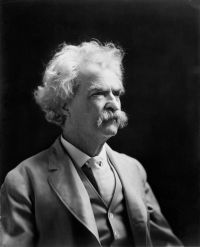 Mark Twain,
Roughing It
(1872)
Mark Twain,
Roughing It
(1872)
“ The cayote lives chiefly in the most desolate and forbidding desert, along with the lizard, the jackass-rabbit and the raven, and gets an uncertain and precarious living, and earns it. He seems to subsist almost wholly on the carcases of oxen, mules and horses that have dropped out of emigrant trains and died, and upon windfalls of carrion, and occasional legacies of offal bequeathed to him by white men who have been opulent enough to have something better to butcher than condemned army bacon. ”
Mark Twain,
Roughing It
(1872)
“ Even at this day it thrills me through and through to think of the life, the gladness and the wild sense of freedom that used to make the blood dance in my veins on those fine overland mornings! Along about an hour after breakfast we saw the first prairie-dog villages, the first antelope, and the first wolf. If I remember rightly, this latter was the regular cayote (pronounced ky-o-te) of the farther deserts. And if it was, he was not a pretty creature or respectable either, for I got well acquainted with his race afterward, and can speak with confidence. ”
 William Henry Giles Kingston,
The Western World
William Henry Giles Kingston,
The Western World
“ Hawks and eagles, hovering high in air, often pounce down and carry off unfortunate members of the community in their powerful talons. The savage cayote, or prairie-wolf, when pressed by hunger during the winter, frequently attacks the dome-shaped habitation of the little animal, and with claws and teeth tears to pieces the walls, plunging his nose into the passage which he has opened, and working his way down till he seizes the trembling little inmate, who in vain retreats to the inmost recesses of his abode. ”
Mark Twain,
Roughing It, Part 1
“ It is considered that the cayote, and the obscene bird, and the Indian of the desert, testify their blood kinship with each other in that they live together in the waste places of the earth on terms of perfect confidence and friendship, while hating all other creature and yearning to assist at their funerals. ”
William F. Drannan, Thirty-One Years on the Plains and in the Mountains…
“ Johnnie West went back and got our pack-mules. We dressed our buffalo and had plenty of meat to load all of our mules, and some to leave there for the hungry cayotes. That night while we were cooking some of the meat for supper, the cayotes raised a howl and it seemed as though they would take possession of our camp in spite of us; but by firing a shot among them once in a while, we were able to keep them at bay.In those days hunters never took along anything to eat, for a man that could not kill what he could eat was considered worthless. ”
“ As he lies down the wolves are upon him. They are clinging to the shaggy form, like blood-hounds, before it has even sunk to the sod, and the victim never rises again.The cayotes are very cowardly, and when carcasses are plenty, sleep during the day in their holes, which are generally dug into the sides of some ravine. If found during the hours of light, it is usually skulking [230] in the hollows near their burrows. They have a decidedly disagreeable penchant for serenading travelers' camps at night, so that our late experience, the guide assured me, was by no means uncommon. ”
“ A coyote ran up a slope toward him, halted with forefeet planted on a rock, and stared at him, ears perked like an inquisitive dog. Casey stopped, eased his rifle out of the crease in the back of the seat cushion, chanced a shot,—and his luck held. He climbed out, picked up the limp gray animal, threw it into the tonneau and went on. Even with twenty-five thousand dollars in his pocket, Casey told himself that coyote hides are not to be scorned. He had seen the time when the price of a good hide meant flour and bacon and tobacco to him. He would skin it when he stopped to eat. ”
Richard Lydekker, 1911 Encyclopædia Britannica, Volume 7… (1911)
“ Ranging from Canada in the north to Guatemala in the south, and chiefly frequenting the open plains on both sides of the chain of the Rocky Mountains, the coyote, under all its various local phases, is a smaller animal than the true wolf, and may apparently be regarded as the New World representative of the jackals, or perhaps, like the Indian wolf (C. pallipes) , as a type intermediate between wolves and jackals. In addition to its inferior size, the coyote is also shorter in the leg than the wolf, and carries a more luxuriant coat of hair. ”
Walter Woelber Dalquest, Mammals of Washington, Volume 2
“ Many actions of the coyote are doglike, and were it not for the large, round, bushy tail, a coyote might easily be mistaken for a dog. The tail is carried in a drooped position with the tip bowed slightly backwards. When badly frightened and running at full speed the tail is stretched out straight behind. The ordinary gait is a purposeful trot with the head held erect, the ears pricked up, and the legs moving smoothly and effortlessly. Near Moses Lake, Grant County, I watched a coyote trot along the side of one of a series of small sand dunes. ”
F. W. Grey, Seeking Fortune in America
“ I was telling a coyote story for which I cannot vouch, but I myself had an experience with a coyote one night when I was on a fishing trip on the Nueces River.I and Ed Anderson, my pit boss, hired a wagon, and taking along a Mexican and his twelve-year-old boy (to cook and look after the horses) , we drove down to the ranch, about forty miles below the mines, for a couple of weeks’ fishing. One night we were all sleeping soundly, when I was awakened by Anderson’s dog fighting with something at my feet. I sat up, and in the bright moonlight saw it was a coyote. ”
Ella M. Sexton, Stories of California
“ Of all the great herds of graceful, fast-running antelope, once the most plentiful of our wild animals, only a very few can now be found on the eastern slopes of the Sierras. But Master Coyote, who might well be spared, so cruel and cowardly is he, still sneaks up and down the whole state, and his quick sharp bark gives notice that the rascal is ready to steal a chicken or a lamb if it is not protected. With his bushy tail and large head he is half fox and half wolf in appearance, and mean enough in habits to be both. ”
 Ernest Thompson Seton,
Wild Animals at Home
Ernest Thompson Seton,
Wild Animals at Home
“ The naturalist finds the Coyote interesting for other reasons. When you see that sleek gray and yellow form among the mounds of the Prairie-dog, at once creating a zone of blankness and silence by his very presence as he goes, remember that he is hunting for something to eat; also, that there is another, his mate, not far away. [Pg 5] For the Coyote is an exemplary and moral little beast who has only one wife; he loves her devotedly, and they fight the life battle together. ”
Enos A. Mills, Watched by Wild Animals
“ The prairie dog likes to keep close to his hole, or to the hole of a neighbour into which he can duck and escape the surprise raids of the coyote.The coyote stalks patiently, hiding until a dog comes close or is too far from his hole to outrun the coyote to it. Coyotes hunt in pairs or fours and often while one, two, or three of them are holding the attention of the dogs the other coyote makes a sudden dash. Sometimes they take sheer delight in stirring up things in congested corners of dog town. ”
Ernest Thompson Seton,
Wild Animals at Home
“ Burning to distinguish himself, that pup set off at full speed, and every time he struck the ground he let off a war-whoop. Away went the Coyote and it looked like a good race to us, and to the Picket-pin Ground-squirrels that sat up high on their mounds to rejoice in the spectacle of these, their enemies, warring against each other.The Coyote has a way of slouching along, his tail dangling and tangling with his legs, and his legs loose-jointed, mixing with his tail. He doesn't seem to work hard but oh! how he does cover the prairie! ”
Mary Austin, The Land of Little Rain
“ The raven will eat most things that come his way,—eggs and young of ground-nesting birds, seeds even, lizards and grasshoppers, which he catches cleverly; and whatever he is about, let a coyote trot never so softly by, the raven flaps up and after; for whatever the coyote can pull down or nose out is meat also for the carrion crow. And never a coyote comes out of his lair for killing, in the country of the carrion crows, but looks up first to see where they may be gathering. ”
“ When Coyote got back, Yélapahi had finished the sweat-house.82 Together they built the fire, heated the stones, and spread the carpet of leaves. Coyote hung over the doorway four blankets of sky,—one white, one blue, one yellow, and one black, and put the hot stones into the lodge. Then they hung their arms and clothes on a neighboring tree, entered the sudatory, and sat down.83 249. “Now,” said Coyote, “if you want to become a fast runner, I will show you what to do. You must cut the flesh of your thigh down to the bone and then break the bone. ”
 Lewis Spence,
The Myths of the North American Indians
Lewis Spence,
The Myths of the North American Indians
“ Another version of the Coyote myth current in California describes how in the beginning there was only the primeval waste of waters, upon which Kodoyanpe and Coyote dropped in a canoe. Coyote willed that the surf beneath them should become sand. "Coyote was coming. He came to Got'at. There he met a heavy surf. He was afraid that he might be drifted away, and went up to the spruce-trees. He stayed there a long time. Then he took some sand and threw it upon that surf: 'This shall be a prairie and no surf. The future generations shall walk on this prairie!' Thus Clatsop became a prairie. ”
 George Bird Grinnell,
Jack, the Young Ranchman: A Boy's Adventures in the Rockies
George Bird Grinnell,
Jack, the Young Ranchman: A Boy's Adventures in the Rockies
“ Sturgis laughed when the question was asked, and Hugh smiled, too. "Son," he said, "your uncle, here, asked me that same question about six years ago, when he first saw a badger and a coyote acting that way. I have seen it a heap of times, and I'll tell you what I believe it means. You know, in these days, since there ain't no buffalo, any more, the coyotes are pretty nearly always hungry. I believe that a coyote sometimes, when he finds a badger out on the prairie, just keeps a-bothering him and a-bothering him until he gets the badger right mad, and gets him so he wants to fight. ”
 L. Frank Baum,
Aunt Jane's Nieces and Uncle John…
(1911)
L. Frank Baum,
Aunt Jane's Nieces and Uncle John…
(1911)
“ Uncle John stood looking into the darkness as if trying to discern the creature."Are coyotes considered dangerous?" he asked the Canadian."Not to us," replied Wampus. "Sometime, if one man be out on mesa alone, an' plenty coyote come, he have hard fight for life. Coyote is wild dog. He is big coward unless pretty hungry. If I leave light burn he never come near us." ”
H. Bedford-Jones, Cactus and Rattlers — Chapter V (1924)
“ There is nothing swifter than the strike of a sidewinder—but the coyote saw the lurking death just in time. A frantic yap of fear broke from his jaws. He gave a desperate twist sidewise in mid-leap—a doubling-up of his body that evaded the reptile's blow—and in mad panic came down and leaped again, blindly. He landed squarely in the matted cholla. Agonized howls rent the air, and sticks and bones and odd objects from the pack-rat's nest were hurled about; the coyote became a whirlwind of furry agony from which proceeded howl upon howl of anguish. ”
 Lafayette Houghton Bunnell,
Discovery of the Yosemite, and the Indian War of 1851…
Lafayette Houghton Bunnell,
Discovery of the Yosemite, and the Indian War of 1851…
“ As we rode, drove after drove of antelope and elk were seen, and one small band of mustangs approached from the west, when, after vainly neighing to our mules, they turned and galloped back toward their favorite resort, the west side of 268 the valley. Sometimes, with a halting look of scrutiny, a coyote would cross our trail, but their near vicinity was always recognized by our vigilant mules with a snort and pause in their gait, that was probably designed to intimate to us that it might be another bear. ”
Mary Austin, The Land of Little Rain
“ I am persuaded that the coyotes in my valley, which is narrow and beset with steep, sharp hills, in long passages steer by the pinnacles of the sky-line, going with head cocked to one side to keep to the left or right of such and such a promontory. I have trailed a coyote often, going across country, perhaps to where some slant-winged scavenger hanging in the air signaled prospect of a dinner, and found his track such as a man, a very intelligent man accustomed to a hill country, and a little cautious, would make to the same point. ”
Mary Austin, The Land of Little Rain
“ The fox is no great talker, but the coyote goes garrulously through the dark in twenty keys at once, gossip, warning, and abuse. They are light treaders, the split-feet, so that the solitary camper sees their eyes about him in the dark sometimes, and hears the soft intake of breath when no leaf has stirred and no twig snapped underfoot. The coyote is your real lord of the mesa, and so he makes151 sure you are armed with no long black instrument to spit your teeth into his vitals at a thousand yards, is both bold and curious. Not so bold, however, as the badger and not so much of a curmudgeon. ”
 Joseph K. Dixon,
The Vanishing Race: The Last Great Indian Council
Joseph K. Dixon,
The Vanishing Race: The Last Great Indian Council
“ Old Man Coyote, after he had created man and woman, did not have anything to do, so he made a bow [pg 138] and arrow. He took the flint for the arrowhead, and with it he killed the buffalo. Then he gave the bow and arrow to the Indian and said to him: ‘This is your weapon.’ The people whom Old Man Coyote created had no knife, so he took the shoulder blade of the buffalo and sharpened it and made it into a knife. These people whom Old Man Coyote had created roamed round over the land and they found a mule. ”
Myths and Legends of British North America
“ But others say that Old One built him a house of transparent ice and put inside of it a log of wood which burns forever. The aurora is the light of Coyote’s fire, shining through the ice, or the reflection of it cast up by the ice. Coyote can hear when people speak his name. When he rolls over in his sleep, it creates the sharp wind which makes the earth so cold.Coyote lived for many years in Nicola Valley. He hunted elk and deer in the winter time, and in the early fall he fished for salmon about six miles above Spence’s Bridge where he had a weir across the Thompson River. ”
 Hubert Howe Bancroft,
The Native Races [of the Pacific states…
Hubert Howe Bancroft,
The Native Races [of the Pacific states…
“ After a few generations have passed, the great chieftain, Coyote, and his immediate progeny are forgotten; meanwhile the beast becomes a favorite with the people; he begins to be regarded as privileged; is not hunted down like other beasts; the virtues and exploits of the whole Coyote clan become identified with the brute; the affections of the people are centered in the animal, and finally, all else being lost and forgotten, the descendants of the chieftain, Coyote, are the offspring of the veritable beast, coyote. ”
