Summary

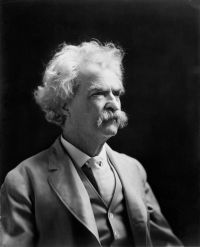
Portrait of Mark Twain Mark Twain,  The American Claimant — Chapter XV (1892)

“ Brady flew. Immediately the sort of quiet began to steal over the crowd which means dawning doubt, misgiving; and might be translated into the words, "Maybe he is expecting a cablegram—maybe he has got a father somewhere—maybe we've been just a little too fresh, just a shade too 'previous'!" Loud talk ceased; then the mutterings and low murmurings and whisperings died out. The crowd began to crumble apart. By ones and twos the fragments drifted to the breakfast table. Barrow tried to bring Tracy in; but he said: "Not yet, Barrow—presently." ”
Source: Wikisource

Portrait of Mark Twain Mark Twain,  The American Claimant — Chapter XV (1892)

“ When he had finished his breakfast, Barrow took him to his room, furnished him a pipe, and said cheerily: "Now, old fellow, take in your battle-flag out of the wet, you're not in the hostile camp any more. You're a little upset by your troubles, and that's natural enough, but don't let your mind run on them anymore than you can help; drag your thoughts away from your troubles by the ears, by the heels, or any other way, so you manage it; it's the healthiest thing a body can do; dwelling on troubles is deadly, just deadly—and that's the softest name there is for it. ”
Source: Wikisource

Portrait of Mark Twain Mark Twain,  The American Claimant — Chapter XV (1892)

“ Tracy's hand went down into his pocket with angry decision. But—it didn't come out. The color began to ebb out of his face. The countenances about him showed a growing interest; and some of them a heightened satisfaction. There was an uncomfortable pause—then he forced out, with difficulty, the words: "I've—been robbed!"
Old Marsh's eyes flamed up with Spanish fire, and he exclaimed: "Robbed, is it? That's your tune? It's too old—been played in this house too often; everybody plays it that can't get work when he wants it, and won't work when he can get it.
”
Source: Wikisource

Get perspective with Kwize: daily news enlightened by great literature