Summary

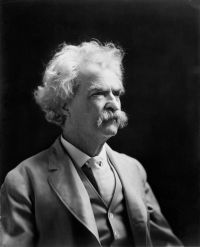
Portrait of Mark Twain Mark Twain The Facts Concerning the Recent Carnival of Crime in Connecticut

I cast the bleeding rubbish into the fire, and drew into my nostrils the grateful incense of my burnt-offering. At last, and forever, my Conscience was dead!
I was a free man! I turned upon my poor aunt, who was almost petrified with terror, and shouted:
“Out of this with your paupers, your charities, your reforms, your pestilent morals! You behold before you a man whose life-conflict is done, whose soul is at peace; a man whose heart is dead to sorrow, dead to suffering, dead to remorse; a man WITHOUT A CONSCIENCE! In my joy I spare you, though I could throttle you and never feel a pang!
Source: Gutenberg

Portrait of Mark Twain Mark Twain The Facts Concerning the Recent Carnival of Crime in Connecticut

Night and day you can find him pegging away at Smith, panting with his labor, sleeves rolled up, countenance all alive with enjoyment. He has got his victim splendidly dragooned now. He can make poor Smith imagine that the most innocent little thing he does is an odious sin; and then he sets to work and almost tortures the soul out of him about it.”
“Smith is the noblest man in all this section, and the purest; and yet is always breaking his heart because he cannot be good! Only a conscience could find pleasure in heaping agony upon a spirit like that. Do you know my aunt Mary's conscience?”
Source: Gutenberg

Portrait of Mark Twain Mark Twain The Facts Concerning the Recent Carnival of Crime in Connecticut

I gave a tramp work; you objected to it—after the contract was made, of course; you never speak up beforehand. Next, I refused a tramp work; you objected to that. Next, I proposed to kill a tramp; you kept me awake all night, oozing remorse at every pore. Sure I was going to be right this time, I sent the next tramp away with my benediction; and I wish you may live as long as I do, if you didn't make me smart all night again because I didn't kill him. Is there any way of satisfying that malignant invention which is called a conscience?
Source: Gutenberg

Get perspective with Kwize: daily news enlightened by great literature