Summary

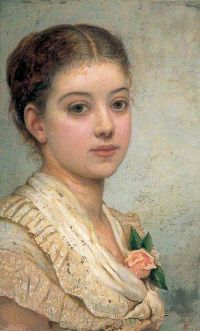
Portrait of Mary Angela Dickens Mary Angela Dickens A Valiant Ignorance; vol. 2 of 3

Romayne, as Loring replied, in the same tone. “You come home to tea with your mother, and you find a friend! Will you have some tea, sir?”
Her face was still a little odd, and unusual-looking, especially about the eyes; and the touch which she laid upon Julian, as if to enforce her words, was strangely clinging and nervous in its quick pressure.
The talk drifted in all sorts of directions after that; all more or less personal, either to the speakers, or to mutual acquaintances. As the moments passed, Loring’s eyes were fixed once or twice, with momentary intentness, on the younger man.
Source: Gutenberg

Portrait of Mary Angela Dickens Mary Angela Dickens A Valiant Ignorance; vol. 2 of 3

It doesn’t matter whether one’s rich or poor, it doesn’t matter whether people think well of us—we can’t always make them, and we can’t all be rich. But we can all be good, dear. Heaven means us all to be good, don’t you think? Oh, if it didn’t, if it wasn’t that that mattered most of all down at the bottom, what would the world come to be like? And why should anybody go on living!”
Julian Romayne was very young.
Source: Gutenberg

Portrait of Mary Angela Dickens Mary Angela Dickens A Valiant Ignorance; vol. 2 of 3

It was Julian’s own private Julian, a personality developed side by side with the sudden and violent re-adjustment of his conception of his relations with the world, who was looked up to, listened to, respected, and deferred to during the hour’s walk which lay between that side-street out of Piccadilly and a certain little street out of the Hammersmith Road. A vague, undefined craving for pre-eminence and admiration had risen in him with his realisation of his dependence, and the reflected nature of the light with which he shone in society.
Source: Gutenberg

Get perspective with Kwize: daily news enlightened by great literature