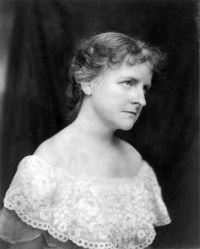
Mary E. Wilkins Freeman

Mary E. Wilkins Freeman

Summary

Portrait of Mary E. Wilkins Freeman Mary E. Wilkins Freeman The Doctor's Horse (1900)

Now and then the Horse used to look around at the empty buggy as he stood at the gate of a patient's house, to see if the Doctor were there, but the will which held the reins, being still evident to his consciousness, even when its owner was absent, kept him in his place. He would have no thought of taking advantage of his freedom; he would turn his head and droop it in that curve of utter submission, shift his weight slightly to another foot, make a sound which was like a human sigh of patience, and wait again.
Source: Wikisource

Portrait of Mary E. Wilkins Freeman Mary E. Wilkins Freeman The Doctor's Horse (1900)

Even on those mornings the Horse would stand at the door of the patient who was ill with old-fashioned consumption or chronic liver disease, his four legs planted widely, his head and neck describing a long downward curve, so expressive of submission and dejection that it might have served as a hieroglyphic for them, and no more thought of letting those bounding impulses of his have their way than if the Doctor's will had verily bound his every foot to the ground with unbreakable chains of servitude.
Source: Wikisource

Portrait of Mary E. Wilkins Freeman Mary E. Wilkins Freeman The Doctor's Horse (1900)

All the timid women folk in the village looked upon him with favor; the Doctor's wife, who was nervous, loved to drive with her husband behind this docile Horse, and was not afraid even to sit, while the Doctor was visiting his patients, with the reins over the animal's back. The Horse had become to her a piece of mechanism absolutely under the control of her husband, and he was, in truth, little more. Still, a furnace is a furnace, even when the fire runs low, and there is always the possibility of a blaze.
Source: Wikisource

Get perspective with Kwize: daily news enlightened by great literature