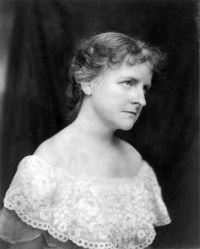
Mary E. Wilkins Freeman

Mary E. Wilkins Freeman

Summary

Portrait of Mary E. Wilkins Freeman Mary E. Wilkins Freeman The Slip of the Leash (1904)

The next day but one, Adam returned to his shack, but he was in despair. That had come which he had foreseen. All day he sat on a ledge of stone near his shack, reflecting. It was a beautiful day in spring, and a sudden warm spell had brought out the leaves on the trees. His feet were sunken in a bed of wild flowers. He heard running water and pipes of birds, and it seemed to him that he also heard something else — the trumpet of freedom of life and earth which calls a man to the battle-field of God.
Source: Wikisource

Portrait of Mary E. Wilkins Freeman Mary E. Wilkins Freeman The Slip of the Leash (1904)

Adam Andersen was over forty when he left a wife and four children, and a comfortable home, and went, not to the bad — that was not the word for it — but to that which is outside the good or the bad, to freedom from all cords and weights of civilized life. He lived, anyway, on the outskirts of civilization, where he could hear and see, and smell with his sharpened nostrils, that which was outside. He lived in one of the far Western States, on a fine farm which he himself had wrested from the wild.
Source: Wikisource

Portrait of Mary E. Wilkins Freeman Mary E. Wilkins Freeman The Slip of the Leash (1904)

Adam Andersen had simply attired himself in some stout clothes and put a few necessaries in the rude old knapsack which he had borne over his shoulders when he first came to those parts, and one night when his wife and family were at a Christmas gathering in the school-house, three miles away, he had stepped — or rather leaped, so glad was the new sense of freedom in him — over the indefinite barrier which kept the settlement from the wild, the civilized man from the savage, and in a trice he was what he had been before he had known himself.
Source: Wikisource

Get perspective with Kwize: daily news enlightened by great literature