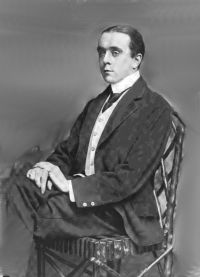
Max Beerbohm

Max Beerbohm

Summary

Portrait of Max Beerbohm Max Beerbohm Zuleika Dobson — Chapter 22 (1911)

This was a stroke so unexpected that it left Katie mute. It equally surprised Noaks, who had been about to throw himself on his knees and implore this girl not to betray him. He was quick, though, to clinch his advantage.
"This," he said, "is the first time I have caught you. Let it be the last."
Was this the little man she had so long despised, and so superciliously served? His very smallness gave him an air of concentrated force. She remembered having read that all the greatest men in history had been of less than the middle height.
Source: Wikisource

Portrait of Max Beerbohm Max Beerbohm Zuleika Dobson — Chapter 22 (1911)

It is easier, as Michelet suggested, for a woman to change her opinion of a man than for him to change his opinion of himself. Noaks, despite the presence of mind he had shown a few moments ago, still saw himself as he had seen himself during the past hours: that is, as an arrant little coward—one who by his fear to die had put himself outside the pale of decent manhood. He had meant to escape from the house at dead of night and, under an assumed name, work his passage out to Australia —a land which had always made strong appeal to his imagination.
Source: Wikisource

Portrait of Max Beerbohm Max Beerbohm Zuleika Dobson — Chapter 22 (1911)

Noaks' boots always in the early morning, when there were so many other things to be done, instead of choosing her own time. Her annoyance had been all the keener because Mr. Noaks' boots more than made up in size for what they lacked in number. Either of them singly took more time and polish than any other pair imaginable. She would have recognised them, at a glance, anywhere. Even so now, it was at a glance that she recognised the toes of them protruding from beneath the window-curtain. She dismissed the theory that Mr. Noaks might have gone utterly unshod to the river.
Source: Wikisource

Get perspective with Kwize: daily news enlightened by great literature