Summary

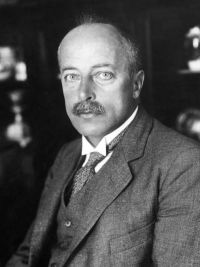
Portrait of Max von Laue Max von Laue On the Conception of the Current of Energy (1912)

In both cases we can imagine a closed surface moving with the velocity through which passes no energy. As we can disregard the absorption, this surface always includes the same quantum of mechanical or electromagnetical energy. It has, however, always only its signification for one coordinate system. For another system the energy flows in general through the surface.
Source: Wikisource

Portrait of Max von Laue Max von Laue On the Conception of the Current of Energy (1912)

Therefore I will adduce an instance which shows independently of every special theory, that the velocity of the energy cannot be transformed in the same way as the velocity of a material point. We consider three coordinate systems, moving uniformly relative to one another; the latter two will have the velocity relative to . A body subjected to a tension (negative pressure) equal in all directions is in rest relative to . In the system it has the velocity , in the velocity .
Source: Wikisource

Portrait of Max von Laue Max von Laue On the Conception of the Current of Energy (1912)

For no energy current passes through the surface, it does, however, in and . But this representation fails altogether when absorption takes place, because then inside such a surface the energy would gradually diminish indefinitely. Therefore it seems to me that no great importance can be attributed to the conception of the velocity of the energy.
Source: Wikisource

Get perspective with Kwize: daily news enlightened by great literature