Summary

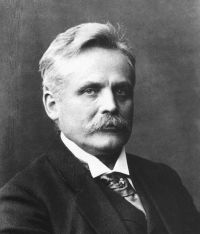
Portrait of Wilhelm Wien Wilhelm Wien Translation:On the Possibility of an Electromagnetic Foundation of Mechanics (1901)

It is without doubt one of the most important tasks of theoretical physics, to connect with each other the, at the beginning, completely isolated areas of mechanical and electromagnetic phenomena, and to derive the differential equations applying to any of them from a common foundation. Maxwell and Thomson and subsequently Boltzmann and Hertz, have taken the, at the beginning, surely natural way to chose mechanics as the foundation and to derive Maxwell's equations from it.
Source: Wikisource

Portrait of Wilhelm Wien Wilhelm Wien Translation:On the Possibility of an Electromagnetic Foundation of Mechanics (1901)

Because when no external force is acting, the law of inertia is simply the law of conservation of electromagnetic energy, and the second law of Newton says here, that the work expended by the force during , is equal to the corresponding change of electromagnetic energy.
The third law of Newton, that maintains the equality of action and reaction, holds for all electrostatic forces between electric quanta. The mechanical forces must, for our stand point, identified with such forces. Since we make the assumption of a resting aether, this law doesn't hold for the general electromagnetic forces.
Source: Wikisource

Portrait of Wilhelm Wien Wilhelm Wien Translation:On the Possibility of an Electromagnetic Foundation of Mechanics (1901)

If we confine ourselves to small velocities, then we have the same expression for the kinetic energy, that is stated by mechanics for the living force. The magnitude of acceleration, however, cannot be derived from that without further ado.
Acceleration presupposes a variability of velocity. The expressions for electromagnetic energy, however, are only derived under the assumption of a time-independent value of velocity.
Source: Wikisource

Get perspective with Kwize: daily news enlightened by great literature