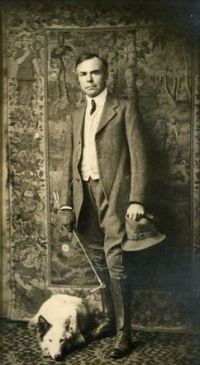
Melville Davisson Post

Melville Davisson Post

Summary

Portrait of Melville Davisson Post Melville Davisson Post The Man Hunters: Scotland Yard (1916)

They do not believe that a criminal can be distinguished because his temperature rises when the crime is discussed before him; or that one can put a gauge on his wrist and determine his guilt by his quickening pulse. A superintendent at Scotland Yard is very apt to smile when you tell him that Prof. Hans Gross, of the University of Gratz, asserts that what a woman suspected of crime does not say in words, or express in her features or by the movement of her hands, can always be determined by the position of her feet.
Source: Wikisource

Portrait of Melville Davisson Post Melville Davisson Post The Man Hunters: Scotland Yard (1916)

On the other hand, Scotland Yard justifies its system on the ground that criminals must all be convicted by a jury, and that juries in England absolutely are not to be moved by metaphysical refinements.
"We define a crime roughly as a violation of the law," they say, "and not, like the Germans, as 'the product of the physiologically grounded psyche of the criminal and his environing external conditions.'
"We engage a constable in man-hunting, and not a professor of psychology."
Source: Wikisource

Portrait of Melville Davisson Post Melville Davisson Post The Man Hunters: Scotland Yard (1916)

NO constable in England would bother to make such observations. They say at Scotland Yard that the common belief that a criminal in a strange country, in attempting to escape in the night, always returns to the theater of crime is not reliable; and if it were it could not be explained by the German theory that in the night the right eye sees objects on the right too small, and the left eye sees objects on the left too small. Consequently, according to the eye in control, there is a tendency in the moving person to turn in nearer to either the right or left.
Source: Wikisource

Get perspective with Kwize: daily news enlightened by great literature