Summary

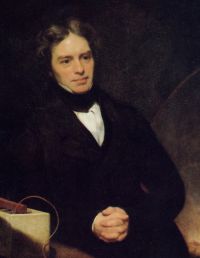
Portrait of Michael Faraday Michael Faraday,  Experimental researches in electricity…

“ There is every reason to believe that the magnet or magnetic needle will become an excellent measurer of the conducting power of substances rotated near it; for I have found by careful experiment, that when a constant current of electricity was sent successively through a series of wires of copper, platina, zinc, silver, lead, and tin, drawn to the same diameter; the deflection of the needle was exactly equal by them all. It must be remembered that when bodies are rotated in a horizontal plane, the magnetism of the earth is active upon them. ”
Source: Wikisource

Portrait of Michael Faraday Michael Faraday,  Experimental researches in electricity…

“ Nothing can be more clear, therefore, than that with iron, and bodies admitting of ordinary magnetic induction, _opposite_ poles on opposite sides of the edge of the plate neutralize each other's effect, whilst _similar_ poles exalt the action; a single pole end on is also sufficient. But with copper, and substances not sensible to ordinary magnetic impressions, _similar_ poles on opposite sides of the plate neutralize each other; _opposite_ poles exalt the action; and a single pole at the edge or end on does nothing. ”
Source: Wikisource

Portrait of Michael Faraday Michael Faraday,  Experimental researches in electricity…

“ No other known power has like direction with that exerted between an electric current and a magnetic pole; it is tangential, while all other forces, acting at a distance, are direct. Hence, if a magnetic pole on one side of a revolving plate follow its course by reason of its obedience to the tangential force exerted upon it by the very current of electricity which it has itself caused, a similar pole on the opposite side of the plate should immediately set it free from this force; for the currents which tend to be formed by the action of the two poles are in opposite directions ”
Source: Wikisource

Get perspective with Kwize: daily news enlightened by great literature