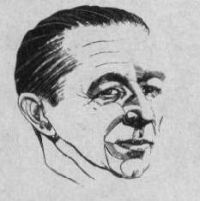
Murray Leinster

Murray Leinster

Summary

Portrait of Murray Leinster Murray Leinster Men into space (1960)

The deep, dark, abysmally black night had fallen. Low down at the western horizon Earth hung, blue-green and glamorous, just above the crests of many ring mountains. It was a little past first quarter, and it gave only the faintest of light to the tortured and splintered rock formations outside Grimaldi Base. When Earth was full, there would be bright earthlight on the moon, and the moon's surface would look much stranger than any painter of fantastic pictures could imagine.
Inside the base, McCauley was going toward his office when a hand touched his arm. It was Kent.
Source: Gutenberg

Portrait of Murray Leinster Murray Leinster Men into space (1960)

He saw the Platform, almost incredibly dim in the moonlight.
He jumped against the mass of the air tank and harness together. In seconds he could see that he was moving closer toward the silvery, spidery framework in the moonshine. He kept himself still. Nothing he could do now would add anything to his chance for life, and exertion would lessen the time left before he suffocated for lack of air.
He relaxed by an iron effort of will. He had gambled. He could win or he could lose. But he must keep the calmness of a man who sees the stakes down and waits for the outcome.
Source: Gutenberg

Portrait of Murray Leinster Murray Leinster Men into space (1960)

The ship went on. Ahead and off to the right lay the steady, last-quarter crescent of Venus. Above and below and on every hand there were stars. Nobody on Earth ever sees the stars as they appear in space. At the bottom of Earth's atmosphere, the keenest eye can see no more than three thousand stars at any one time. Out here one could count as many in a circle no larger than the sun's disk.
Source: Gutenberg

Get perspective with Kwize: daily news enlightened by great literature