Summary

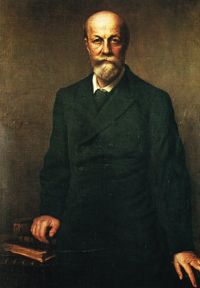
Portrait of Mór Jókai Mór Jókai Eyes Like the Sea: A Novel

Often and often I thought how accurately this young woman had foretold all these things of herself when we sat beside each other in my little wooden hut on the Comorn islet. In a straw-hut, in a cow-stall, in a besieged fortress, in a bare barrack, in the tent of an itinerant player, at the bivouac of an out-camping soldier—anywhere and everywhere, it is Love that makes us happy, and its sweet illusion can conjure up fairy palaces out of these wretched surroundings. And remember, too, that an officer in the field is by no means an amiable husband.
Source: Gutenberg

Portrait of Mór Jókai Mór Jókai Eyes Like the Sea: A Novel

How is it that nobody disturbs this sweet idyll of yours? Is the one man who is so confoundedly nearly interested in your happiness, is that man still alive? Does Muki Bagotay still exist anywhere in the wide world?"
"I fancy so."
"Well, if he does, I'll only say that what flows through his veins is milk, not blood. Is he content to carry the horns of his hundred oxen? A rich and powerful landlord, a county magnate, and the master of your ideal peasant!—A thousand lightnings! if I were only in his place!"
Bessy, with a sarcastic smile, folded her hands together above her knees.
Source: Gutenberg

Portrait of Mór Jókai Mór Jókai Eyes Like the Sea: A Novel

At the new seat of the Hungarian Government, Debreczin, we were huddled together in a tiny little room, compared with which the hut of Peter Gyuricza was a palace from the Thousand-and-one Nights. And my queen worked like a slave, like the wife of a Siberian convict. She worked not for a joke, not in sheer defiance; she did not play the part of a peasant girl, she was a serving-woman in grim earnest.
The hazard of the die of war changed. We advanced. We marched in triumph from one battle-field to another.
Source: Gutenberg

Get perspective with Kwize: daily news enlightened by great literature