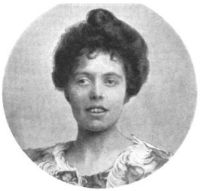
Netta Syrett

Netta Syrett

Summary

Portrait of Netta Syrett Netta Syrett The day's journey (1906)

Mayne said nothing. He had seated himself once more in the arm-chair, and Rose was aware of the rigidity of his attitude. It was as though his body had become suddenly frozen.
She went on, not quite steadily. “You hate me for saying it, of course. So should I, if I were you. But, Dick—you and I are not by nature self-deceivers. We think straight. And when one person loves, even though the other does not, is it quite safe? There comes a weak moment—a sense of the dreariness of life—gratitude on one side; on the other a strong emotion. Oh, Dick, you know as well as I do.”
Source: Gutenberg

Portrait of Netta Syrett Netta Syrett The day's journey (1906)

He was Robert, and mad, childish, futile as it was, it was just that which made the truth impossible.
She looked round her. The sunshine on the grass was hateful, the warm blue sky an insult. All beauty was a lie, a meaningless, soulless lie, like the love of men and women, which held no faith, no steadfastness, no pity even.
She thought of her five years of married life. Five years of self-immolation in which she had known no desires, no ambitions, no joys except through the desires, the ambitions, the joys of her husband.
Source: Gutenberg

Portrait of Netta Syrett Netta Syrett The day's journey (1906)

At ten o’clock, when Philippa went to Robert’s study, Cecily was at work in her own room, whence she did not emerge till after the secretary’s hour for departure. With all her strength she strove to forget her presence in the house, and the effort, at first apparently impossible, became at last no effort at all. Gradually her work absorbed her; gradually she began to live in another world of her own creating, often so completely that she woke with a start to the consciousness of her outward existence, in so far as it was connected at all with her husband.
Source: Gutenberg

Get perspective with Kwize: daily news enlightened by great literature