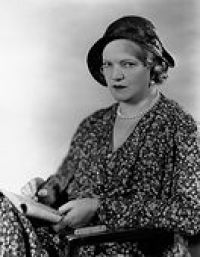
Nina Wilcox Putnam

Nina Wilcox Putnam

Summary

Portrait of Nina Wilcox Putnam Nina Wilcox Putnam The Byroad to Nazareth (1912)

It bore the laurel-wreathed image of a man with a big nose, and curious words that were like those in the detested Latin grammar. It was very heavy, too. The Worst Boy rubbed it on his knee, bit it, hurt his mouth, and then clenched it secretively in the moist hollow of his hand, as a horseman clattered up over the hill from Rand. Almost at the same time there appeared a second horseman along the highroad from Nazareth; and at the fork the two drew rein and exchanged greetings. The first to speak was the young sheriff, who pulled off his wide-brimmed hat and wiped his serious pink face.
Source: Wikisource

Portrait of Nina Wilcox Putnam Nina Wilcox Putnam The Byroad to Nazareth (1912)

Very softly he pushed the growing things aside, until finally he could peer through a tangled web of green at a picture like a page out of a storybook.
At one side of a little clearing ran the brook. Close beside it, and forming a second side to the square, stood the painted wagon, its shafts upon the ground, its curtains flung wide, disclosing a disordered interior, where only the little gold gods upon the hanging shelf were in their usual place.
Source: Wikisource

Portrait of Nina Wilcox Putnam Nina Wilcox Putnam The Byroad to Nazareth (1912)

Ride with me as far as the creamery.”
“All right!” said the young sheriff, wheeling his horse about. “I hear that this gypsy feller is powerful strong. D’yer know he broke the winder bars with his bare hands?”
The rest of his speech was lost in the clatter of hoofs; and again the Worst Boy was left sentinel at the fork. He looked at the sun. It was high noon now, and he was hungry. From the distant village came the faint chime of a bell. School was out! It would be safe to go home now.
Source: Wikisource

Get perspective with Kwize: daily news enlightened by great literature