Summary

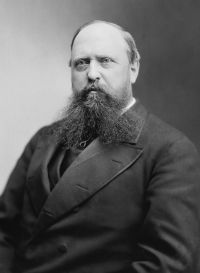
Portrait of Othniel Charles Marsh Othniel Charles Marsh Principal Characters of American Jurassic Dinosaurs… (1878)

On the last two or three cervical vertebræ of Brontosaurus, there is a convoluted ridge of bone over the posterior zyga-pophyses. In the anterior dorsals, this ridge becomes stronger and more elongated, forming a distinct protuberance. These processes have not hitherto been described. As they are analogous to the processes in mammals known as meta-pophyses, they may bear the same general name, being distinguished as the post-metapophyses. The term pre-metapophyses should then be applied to the processes in mammals.
Source: Wikisource

Portrait of Othniel Charles Marsh Othniel Charles Marsh Principal Characters of American Jurassic Dinosaurs… (1878)

The tail was large, and nearly all the bones solid.
The diminutive head will first attract attention, as it is smaller in proportion to the body than in any vertebrate hitherto known. The entire skull is less in diameter or actual weight than the fourth or fifth cervical vertebra.
A careful estimate of the size of Brontosaurus, as here restored, shows that when living the animal must have weighed more than twenty tons. The very small head and brain, and slender neural cord, indicate a stupid, slow moving reptile.
Source: Wikisource

Portrait of Othniel Charles Marsh Othniel Charles Marsh Principal Characters of American Jurassic Dinosaurs… (1878)

All the precaudal vertebræ have large cavities in the centrum, communicating exteriorly with the surface by means of large lateral foramina. This cavernous structure of the vertebræ gradually decreases posteriorly, until in the anterior caudal vertebræ it is confined to a small pocket above the transverse process.
Source: Wikisource

Get perspective with Kwize: daily news enlightened by great literature