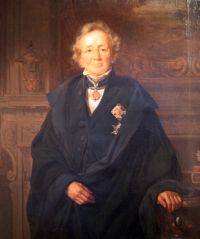
Philip Arthur Ashworth

Philip Arthur Ashworth

Summary

Portrait of Philip Arthur Ashworth Philip Arthur Ashworth 1911 Encyclopædia Britannica, Volume 12… (1911)

To him law was not mere theory, but living force; and this conception of its power animates all his schemes of practical reform. As a teacher he exercised a magnetic influence, not only by reason of the clearness and cogency of his exposition, but also because of the success with which he developed the talents and guided the aspirations of his pupils.
Source: Wikisource

Portrait of Philip Arthur Ashworth Philip Arthur Ashworth 1911 Encyclopædia Britannica, Volume 12… (1911)

As a politician, Gneist’s career cannot perhaps be said to have been entirely successful. In a country where parliamentary institutions are the living exponents of the popular will he might have risen to a foremost position in the state; as it was, the party to which he allied himself could never hope to become more than what it remained, a parliamentary faction, and the influence it for a time wielded in the counsels of the state waned as soon as the Social-Democratic party grew to be a force to be reckoned with. It is as a writer and a teacher that Gneist is best known to fame.
Source: Wikisource

Portrait of Philip Arthur Ashworth Philip Arthur Ashworth 1911 Encyclopædia Britannica, Volume 12… (1911)

He was a man of noble bearing, religious, and imbued with a stern sense of duty. He was proud of being a “Preussischer Junker” (a member of the Prussian squirearchy) , and throughout his writings, despite their liberal tendencies, may be perceived the loyalty and affection with which he clung to monarchical institutions. A great admirer and a true friend of England, to which country he was attached by many personal ties, he surpassed all other Germans in his efforts to make her free institutions, in which he found his ideal, the common heritage of the two great nations of the Teutonic race.
Source: Wikisource

Get perspective with Kwize: daily news enlightened by great literature