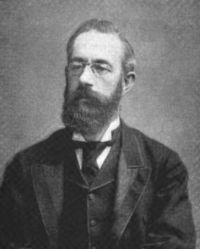
Henry Spenser Wilkinson

Henry Spenser Wilkinson

Summary

Portrait of Henry Spenser Wilkinson Henry Spenser Wilkinson 1911 Encyclopædia Britannica (1911)

A disciple rather of Clausewitz, whose theory of war was an effort to grasp its conditions, than of Jomini, who expounded a system of rules, Moltke regarded strategy as a practical art of adapting means to ends, and had developed the methods of Napoleon in accordance with the altered conditions. He had been the first to realize the great defensive power of modern firearms, and had inferred from it that an enveloping attack had become more formidable than the attempt to pierce an enemy’s front.
Source: Wikisource

Portrait of Henry Spenser Wilkinson Henry Spenser Wilkinson 1911 Encyclopædia Britannica (1911)

Moltke’s plan was to assemble the whole army to the south of Mainz, this being the one district in which an army could best secure the defence of the whole frontier. If the French should disregard the neutrality of Belgium and Luxemburg, and advance on the line from Paris to Cologne or any other point on the Lower Rhine, the German army would be able to strike at their flank, while the Rhine itself, with the fortresses of Coblenz, Cologne and Wesel, would be a serious obstacle in their front.
Source: Wikisource

Portrait of Henry Spenser Wilkinson Henry Spenser Wilkinson 1911 Encyclopædia Britannica (1911)

The Prussian forces were 64,000 short of the adverse total, but Moltke determined to be superior at the decisive point against the Austro-Saxons; he therefore told off 278,000 men for that portion of the struggle, and employed only 48,000 men in Germany proper. His brilliant direction enabled the 48,000 to capture the Hanoverian army in less than a fortnight, and then to attack and drive asunder the south German forces. (2) In dealing with Austro-Saxony the difficulty was to have the Prussian army first ready—no easy matter, as the king would not mobilize until after the Austrians.
Source: Wikisource

Get perspective with Kwize: daily news enlightened by great literature