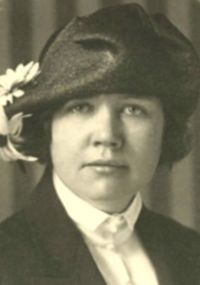
Rose Wilder Lane

Rose Wilder Lane

Summary

Portrait of Rose Wilder Lane Rose Wilder Lane Peaks of Shala (1923)

Now that I am back in my own century, writing of those days in the Albanian mountains, I understand why men so easily slip into the ancient savagery of war and all war’s atrocities. All that we call civilization is like a tune heard yesterday, a little thing floating on the surface of our minds, which sometimes we can keep step to, and then in a moment it is gone so that we cannot remember it.
Upon the trail that day we were barbarians, simple and primitive; we were isolated, small bits of warmth and energy in a hostile universe of stone and rain.
Source: Gutenberg

Portrait of Rose Wilder Lane Rose Wilder Lane Peaks of Shala (1923)

The donkey walked with little, quick, indefatigable steps; the gendarme swung along easily, his rifle on his back; Rexh trudged beside me with his hand on the saddle. The soft earth let us pass without a sound.
“Tired, Rexh?”
“No, Mrs. Lane.”
“What is the matter?”
“I am thinking that you will go away to your own country and forget us. You say you will come back to Albania, but you never will. It is easy to forget when one is far away; the mind changes. A mind is like the water in a river. We will forget you, too.
Source: Gutenberg

Portrait of Rose Wilder Lane Rose Wilder Lane Peaks of Shala (1923)

We were in the sky; there is no other way to say it, and no way in which to describe that sensation of infinite airiness. Forty miles behind and below us Lake Scutari lay flat, like a pool of mercury on a gray-brown floor. At each side of our little gay-colored cavalcade a gray cliff rose perhaps two hundred feet, too sheer to hold the snow that thickly crusted its top. These cliffs were the posts of a gateway through which we looked into the country of the hidden tribes.
I had never seen or dreamed such mountains.
Source: Gutenberg

Get perspective with Kwize: daily news enlightened by great literature