Summary

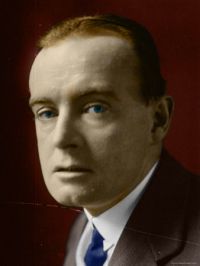
Portrait of Saki Saki Beasts and Super-Beasts — The Boar-Pig (1914)

Ah, le petit charmant!” exclaimed Matilda with enthusiasm.
“Mais non, pas du tout petit, et pas du tout charmant; un bête féroce – ”
“Une bête,” corrected Matilda; “a pig is masculine as long as you call it a pig, but if you lose your temper with it and call it a ferocious beast it becomes one of us at once. French is a dreadfully unsexing language.”
“For goodness’ sake let us talk English then,” said Mrs. Stossen. “Is there any way out of this garden except through the paddock where the pig is?”
Source: Wikisource

Portrait of Saki Saki Beasts and Super-Beasts — The Boar-Pig (1914)

Matilda was of an age when thought is action; she slid down from the branches of the medlar tree, and when she clambered back again Tarquin, the huge white Yorkshire boar-pig, had exchanged the narrow limits of his stye for the wider range of the grass paddock. The discomfited Stossen expedition, returning in recriminatory but otherwise orderly retreat from the unyielding obstacle of the locked door, came to a sudden halt at the gate dividing the paddock from the gooseberry garden.
Source: Wikisource

Portrait of Saki Saki Beasts and Super-Beasts — The Boar-Pig (1914)

Henri Quatre’s address to his soldiers is the only thing I really know in that language.”
“If you will go and fetch some one to drive that animal away I will give you something to buy yourself a nice present,” said Mrs. Stossen.
Matilda came several inches lower down the medlar tree.
“That is the most practical suggestion you have made yet for getting out of the garden,” she remarked cheerfully; “Claude and I are collecting money for the Children’s Fresh Air Fund, and we are seeing which of us can collect the biggest sum.”
Source: Wikisource

Get perspective with Kwize: daily news enlightened by great literature