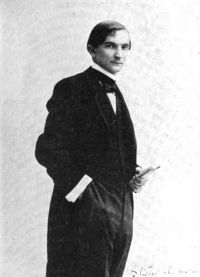
Stacy Aumonier

Stacy Aumonier

Summary

Portrait of Stacy Aumonier Stacy Aumonier Cricket (Aumonier) (1916)

One wicket for no runs! We flung the scarlet symbol backward and forward in a great state of excitement, with visions of a freak match, the whole side of our opponents being out for ten runs, and so on. I remember the glum face of their umpire, a genial corn merchant, dressed in a white coat and a bowler hat, with a bewildering number of sweaters tied round his neck, glancing apprehensively at the pavilion.
Source: Wikisource

Portrait of Stacy Aumonier Stacy Aumonier Cricket (Aumonier) (1916)

We discovered that he was the local wheelwright and the Celminster captain. He showed us our room in the pavilion and called Bunty "sir." Of course Bunty lost the toss. He always did during that week, and this led to considerably more "chipping," and we turned out to field.
No one who has never experienced it can ever appreciate the tense joy of a cricketer when he comes out to begin a match. The gaiety of the morning, when the light is at its best and all one's senses are alert; the sense of being among splendid deeds that are yet unborn; and then the jolly red ball!
Source: Wikisource

Portrait of Stacy Aumonier Stacy Aumonier Cricket (Aumonier) (1916)

It is now the turn of our opponents to take the field, while we eagerly scan the score-sheet to see the order of going in, and restlessly move about the pavilion, trying on pads and making efforts not to appear nervous.
And with what a tense emotion we watch our first two men open the innings! It is with a gasp of relief we see Jimmy Guilsworth cut a fast ball for two, and know, at any rate, we have made a more fortunate start than our opponents did.
Source: Wikisource

Get perspective with Kwize: daily news enlightened by great literature