Summary

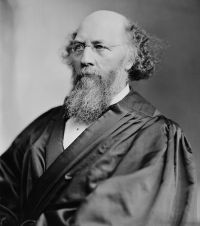
Portrait of Stephen Johnson Field Stephen Johnson Field Moffat v. United States — Opinion of the Court

The position that, as the frauds charged were committed by officers of the United States, the court erred in not holding their acts to be binding, and in not giving to the patents the force of valid conveyances, is certainly a novel one. The government does not guaranty the integrity of its officers, nor the validity of their acts. It prescribes rules for them, requires an oath for the faithful discharge of their duties, and exacts from them a bond with stringent conditions. It also provides penalties for their misconduct or fraud, but there its responsibility ends.
Source: Wikisource

Portrait of Stephen Johnson Field Stephen Johnson Field Moffat v. United States — Opinion of the Court

A patent to a fictitious person is, in legal effect, no more than a declaration that the government thereby conveys the property to no one. There is, in such case, no room for the application of the doctrine that a subsequent bona fide purchaser is protected. A subsequent purchaser is bound to know whether there was, in fact, a patentee, a person once in being, and not a mere myth, and he will always be presumed to take his conveyance upon the knowledge of the truth in this respect.
Source: Wikisource

Portrait of Stephen Johnson Field Stephen Johnson Field Moffat v. United States — Opinion of the Court

The presumption as to the regularity of the proceedings which precede the issue of a patent of the United States for land, is founded upon the theory that every officer charged with supervising any part of them, and acting under the obligation of his oath, will do his duty, and is indulged as a protection against collateral attacks of third parties. It may be admitted, as stated by counsel, that if, upon any state of facts, the patent might have been lawfully issued, the court will presume, as against such collateral attacks, that the facts existed
Source: Wikisource

Get perspective with Kwize: daily news enlightened by great literature