Summary

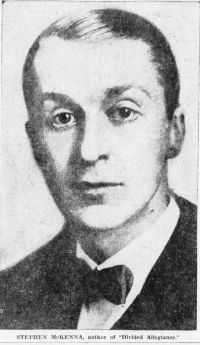
Portrait of Stephen McKenna Stephen McKenna The Confessions of a Well-Meaning Woman… (1922)

A little home-sick for Mount Street and my friends? Indeed, yes; though I have not been neglected. Are not those tulips too magnificent? Were, rather. . . The dear princess brought them a week ago, and I was so touched by her sweetness that I have not the heart to throw them away. If she, to whom I can be nothing but a dull old woman. . . I mean, it brings into relief the unkindness of others; and I do indeed find it hard to forgive the callousness of Spenworth and my brother Brackenbury. No, that—like the operation—I would rather not talk about.
Source: Wikisource

Portrait of Stephen McKenna Stephen McKenna The Confessions of a Well-Meaning Woman… (1922)

Would you not have thought that any uncle would have welcomed the opportunity? I said nothing. And then Brackenbury had the assurance to criticize my way of life and to ask why I kept on the house in Mount Street if it always meant “pulling the devil by the tail,” as he so elegantly expressed it. Why did I not take a less expensive house? And so on and so forth. I suppose he imagined that I could ask the princess to come to Bayswater. . .
“Do not,” I said, “let us discuss the matter any more. It is unpleasant to be a pauper, but more unpleasant to be a beggar.
Source: Wikisource

Portrait of Stephen McKenna Stephen McKenna The Confessions of a Well-Meaning Woman… (1922)

Tom Noddy has left Gloucester Place for Eastbourne or Eastbourne for Gloucester Place. As Tennyson says, “Again—who wonders and who cares?”
At the same time—I loathe Americanisms and I do conscientiously try to express myself in what I may call the English of educated society; we do not seem to have any literary equivalent for “mentality,” so I must ask you to pardon the neologism—will you, to oblige me, try to imagine the “mentality” of Spenworth and Brackenbury?
Source: Wikisource

Get perspective with Kwize: daily news enlightened by great literature