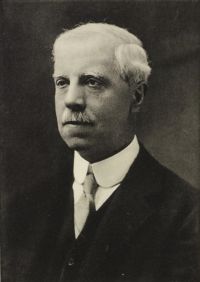
 Thomas Little Heath,
1911 Encyclopædia Britannica, Volume 8…
(1911)
Thomas Little Heath,
1911 Encyclopædia Britannica, Volume 8…
(1911)
“ Diophantus then traces how each element of the equation has arisen, and formulates the auxiliary problem of determining how the assumptions must be corrected so as to lead to an equation (in place of the “impossible” one) which can be solved rationally. Sometimes his x has to do duty twice, for different unknowns, in one problem. In general his object is to reduce the final equation to a simple one by making such an assumption for the side of the square or cube to which the expression in x is to be equal as will make the necessary number of coefficients vanish. ”
