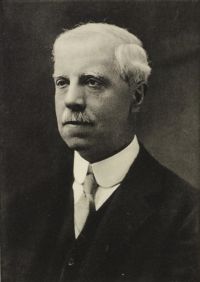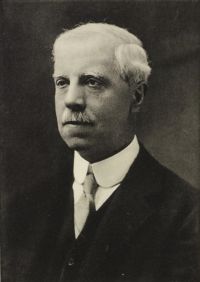
Thomas Little Heath

Biographical details

Portrait of Thomas Little Heath Thomas Little Heath 1911 Encyclopædia Britannica, Volume 20… (1911)

PAPPUS OF ALEXANDRIA, Greek geometer, flourished about the end of the 3rd century A.D. In a period of general stagnation in mathematical studies, he stands out as a remarkable exception. How far he was above his contemporaries, how little appreciated or understood by them, is shown by the absence of references to him in other Greek writers, and by the fact that his work had no effect in arresting the decay of mathematical science. In this respect the fate of Pappus strikingly resembles that of Diophantus.
Source: Wikisource

Portrait of Thomas Little Heath Thomas Little Heath 1911 Encyclopædia Britannica, Volume 8… (1911)

Diophantus then traces how each element of the equation has arisen, and formulates the auxiliary problem of determining how the assumptions must be corrected so as to lead to an equation (in place of the “impossible” one) which can be solved rationally. Sometimes his x has to do duty twice, for different unknowns, in one problem. In general his object is to reduce the final equation to a simple one by making such an assumption for the side of the square or cube to which the expression in x is to be equal as will make the necessary number of coefficients vanish.
Source: Wikisource

Portrait of Thomas Little Heath Thomas Little Heath 1911 Encyclopædia Britannica (1911)

Playfair remarked that the careful investigation of all possible particular cases of a proposition would show that (1) under certain conditions a problem becomes impossible; (2) under certain other conditions, indeterminate or capable of an infinite number of solutions. These cases could be enunciated separately, were in a manner intermediate between theorems and problems, and were called “porisms.”
Source: Wikisource

Get perspective with Kwize: daily news enlightened by great literature