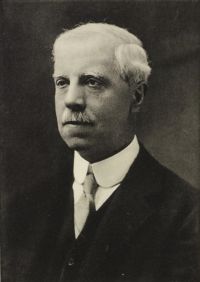
John Sturgeon Mackay

Biographical details

John Sturgeon Mackay,  1911 Encyclopædia Britannica (1911)

“ For the past twenty centuries parts of the Elements, notably the first six books, have been used as an introduction to geometry. Though they are now to some extent superseded in most countries, their long retention is a proof that they were, at any rate, not unsuitable for such a purpose. They are, speaking generally, not too difficult for novices in the science; the demonstrations are rigorous, ingenious and often elegant; the mixture of problems and theorems gives perhaps some variety, and makes their study less monotonous ”
Source: Wikisource

John Sturgeon Mackay,  1911 Encyclopædia Britannica (1911)

“ Proclus preserves a reply made by Euclid to King Ptolemy, who asked whether he could not learn geometry more easily than by studying the Elements—“There is no royal road to geometry.” Pappus of Alexandria, in his Mathematical Collection, says that Euclid was a man of mild and inoffensive temperament, unpretending, and kind to all genuine students of mathematics. This being all that is known of the life and character of Euclid, it only remains therefore to speak of his works.
Among those which have come down to us the most remarkable is the Elements (Στοιχεῖα) (see Geometry) .
”
Source: Wikisource

John Sturgeon Mackay,  Encyclopædia Britannica, Ninth Edition (1878)

“ The fifth book stands alone, depending upon none of the preceding books, and contains the theory of proportion, with respect not merely to geometrical magnitudes, such as lines, angles, areas, solids, but to any magnitudes of which multiples can be formed. The diagrams consist of straight lines, probably for convenience of construction, but the enunciations of the propositions and the reasoning are perfectly general. With the exception of his treatment of parallels, Euclid's doctrine of proportion has been the subject of more discussion than any other part of the Elements. ”
Source: Wikisource

Get perspective with Kwize: daily news enlightened by great literature