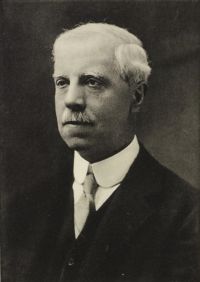
Thomas Little Heath

Thomas Little Heath

Summary

Portrait of Thomas Little Heath Thomas Little Heath 1911 Encyclopædia Britannica (1911)

He is doubtless the same as Theodosius the mathematician, who is mentioned by Strabo amongst the natives of Bithynia distinguished for their learning, and whose sons were also mathematicians, the same, too, as the inventor of a universal sun-dial (horologium πρὸς πᾶν κλίμα) of that name who is praised by Vitruvius (De Architectura, ix. 9) . His date, therefore, could not have been later than the 1st century B.C.
Source: Wikisource

Portrait of Thomas Little Heath Thomas Little Heath 1911 Encyclopædia Britannica (1911)

The lemmas which Pappus gives in connexion with the
porisms are interesting historically, because he gives (1) the fundamental theorem that the cross or an harmonic ratio of a pencil of four straight lines meeting in a point is constant for all transversals; (2) the proof of the harmonic properties of a complete quadrilateral; (3) the theorem that, if the six vertices of a hexagon lie three and three on two straight lines, the three points of concourse of opposite sides lie on a straight line.
Source: Wikisource

Portrait of Thomas Little Heath Thomas Little Heath 1911 Encyclopædia Britannica (1911)

A remarkable feature is the bare statement of a number of very close approximations to the square roots of numbers which are not complete squares. Others occur in the Metrica where also a method of finding such approximate square, and even approximate cube, roots is shown. Hero’s expressions for the areas of regular polygons of from 5 to 12 sides in terms of the squares of the sides show interesting approximations to the values of trigonometrical ratios.
Source: Wikisource

Get perspective with Kwize: daily news enlightened by great literature