Summary

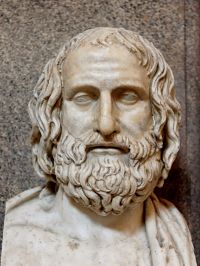
Portrait of Euripides Euripides,  Alcestis (Murray) — Notes (1915)

“ Alcestis does not make light of her sacrifice: she enjoyed her life and values it; she wishes one of the old people had died instead; she is very earnest that Admetus shall not marry again, chiefly for the children's sake, but possibly also from some little shadow of jealousy. A modern dramatist would express all this, if at all, by a scene or a series of scenes of conversation; Euripides always uses the long self-revealing speech. Observe how little romantic love there is in Alcestis, though Admetus is full of it. ”
Source: Wikisource

Portrait of Euripides Euripides,  Alcestis (Murray) — Notes (1915)

“ At one time the beauty and passion of it almost make us forget its ultimate hollowness; at another this hollowness almost makes us lose patience with its beautiful language. In this state of balance the touch of satire in l. 338 f. ("My mother I will know no more," etc.) , and the fact that he speaks immediately after the complete sincerity of Alcestis, conspire to weigh down the scale against Admetus. There can be no doubt that he means, and means passionately, all that he says. Only he could not quite manage to die when it was not strictly necessary. ”
Source: Wikisource

Get perspective with Kwize: daily news enlightened by great literature