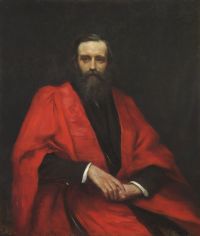
Arthur Woollgar Verrall

Arthur Woollgar Verrall

Summary

Portrait of Arthur Woollgar Verrall Arthur Woollgar Verrall,  Euripides the Rationalist (1895)

“ The labours, for example, the unflinching incessant labours on behalf of humanity! Balaustion recalls them to us incessantly; they are Heracles; he personifies the great love, 'careless of self where others may be helped', which reproves by its mere presence the littleness of Admetus, his counsellors, servants, and the rest of the crew. In Heracles everything must be praised, anything forgiven. If he says, 'Is Admetus at home?', you must revere him: think of his labours! If he drinks till he 'howls discordance', you must not call him a sot, nor let any one do so unrebuked. ”
Source: Wikisource

Portrait of Arthur Woollgar Verrall Arthur Woollgar Verrall,  Euripides the Rationalist (1895)

“ For if it would be surprising and unsatisfactory that without grave cause a body should be entombed on the day of the death, what shall be said of a funeral, which is commenced not merely within the same hour, but at the very minute of the death itself, while the corpse is yet as warm as in life, and almost before the departed voice has ceased to vibrate upon the ear; a funeral, which from that moment to its completion is pushed forward in spite of hindrance with all the speed that forethought and ingenuity can secure? Such is the funeral of Alcestis. ”
Source: Wikisource

Portrait of Arthur Woollgar Verrall Arthur Woollgar Verrall,  Euripides the Rationalist (1895)

“ As a husband he is perhaps not up to the standard, but then what a host! How worthy of the prince, whose prosperity was founded upon his kind treatment of Apollo as a servant in his house, is the suppression of self, which enables him, by concealing the truth, to open his door to the traveller in the very instant of his bereavement! Here lies the unity of the whole play, the moral of which "undoubtedly is, that disinterested hospitality never fails of its reward". So, and with such emphasis of type, says Paley [18] ; and so say the rest in a chorus. ”
Source: Wikisource

Get perspective with Kwize: daily news enlightened by great literature