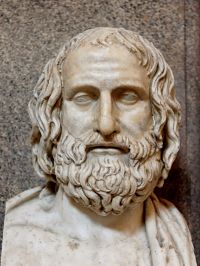
Euripides

Euripides

Summary

Portrait of Euripides Euripides Tragedies of Euripides (1894)

The measured tread of the iambus or trochee, reappearing in stanzas of the same structure, and in lines of the same average length, through chorus after chorus of eighteen plays, produces an impression of monotony and heaviness which is in striking contrast with the swift and ever-varying movement of the metres of the original; and the quivering passion that thrills through the stormy lyric outbursts, which, like cataract and rapid, so often break the even flow of the senarii, is sorely missed when merged in the tranquil stream of blank-verse dialogue.
Source: Wikisource

Portrait of Euripides Euripides Tragedies of Euripides (1894)

A soldier who throws himself in front of his king to receive in his own body the stroke of an assassin or a foe is indeed extolled, but would he not be counted false to his duty, did he, at the supreme moment, shrink behind his king? The especial pathos of the situation to the audience lay in this, that the sacrifice of a young and happy woman was forced upon her by the cowardly selfishness, not of her husband, but of a miserable old man: that Admetus should not have found a substitute at all would have seemed monstrous.
Source: Wikisource

Portrait of Euripides Euripides Tragedies of Euripides (1896)

With the growth of the city came a stir of life, a quickening of commercial enterprise, an awakening of thought, which were also new. Merchants from Egypt, from Spain, from the Black Sea, and from all islands and lands that lie between these, artificers from Tyre, artists, poets, and philosophers from wherever Greek was spoken, all these brought their wealth, their cunning, their wisdom, to the feet of Athens.
Source: Wikisource

Get perspective with Kwize: daily news enlightened by great literature