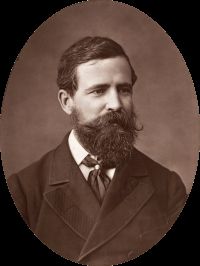
Verney Lovett Cameron

Verney Lovett Cameron

Summary

Portrait of Verney Lovett Cameron Verney Lovett Cameron In Savage Africa

One day while we were all marching along slowly and sadly, no one having any heart for the songs or shouts with which the African usually enlivens his day’s march, I was astonished by seeing a sudden panic seize the carriers, who pitched their loads on the ground and scampering off to the handiest trees commenced to climb them. Hatibu shouted to me to follow him, as with the agility of a monkey he swung himself on to the lower branches of an acacia tree, regardless of the thorns, and I, hardly knowing what I was doing, hastened to place myself beside him.
Source: Gutenberg

Portrait of Verney Lovett Cameron Verney Lovett Cameron In Savage Africa

I do not know that I felt much comfort from her assurance, for I thought if the future had as much suffering in store for me as the past, death would be a merciful release to me. She told me the three men who had been in the canoe with me were all drowned, and I could not help feeling how fate seemed to be against all those who were in any danger with me. First Fumo, then Wanda, then Chaka and Dala, and now these three Balaba, all dead, but I, who had undergone more perils than all of them, was still alive.
Source: Gutenberg

Portrait of Verney Lovett Cameron Verney Lovett Cameron In Savage Africa

O Kifura! he is a slave and a prisoner, it is true; but even slaves and prisoners have feelings, and die like other men; and this man is a white man. Now when Kifura comes to-night to his home, people at the dance will say there is no chief like Kifura, who has brought a white man to Kitaka; and words will go to all that Kifura has a white man at Kitaka, and people will come from all places to see him, and say that Kifura is indeed a big chief.
Source: Gutenberg

Get perspective with Kwize: daily news enlightened by great literature