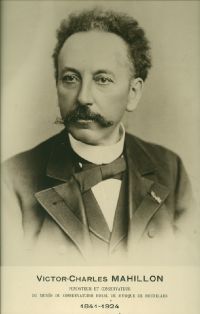
Victor-Charles Mahillon

Victor-Charles Mahillon

Summary

Portrait of Victor-Charles Mahillon Victor-Charles Mahillon Encyclopædia Britannica, Ninth Edition (1888)

TOURNEBOUT, a wind instrument of wood, in which a cylindrical column of air is set in vibration by a reed. The lower extremity is turned up in a half circle, and from this peculiarity it has gained the French names tournebout and cromome, the latter a corruption of the German name Krummhorn. There appears to be no English equivalent. The reed of the tournebout, like that of the bassoon, is formed by two tongues of cane, adapted to the small end of a conical brass tube, the large end being inserted in the body of the instrument.
Source: Wikisource

Portrait of Victor-Charles Mahillon Victor-Charles Mahillon Encyclopædia Britannica, Ninth Edition (1888)

To increase the number of keys, to improve their system of plugging, and to extend the scale of the instrument in the lower region,—these had hitherto been the principal problems dealt with in the improvement of the flute. No maker, no inventor whose labours we have called attention to, had as yet devoted his attention to the rational division of the column of air by means of the lateral holes. In 1831 Theobald Boehm, a Bavarian, happening to be in London, was struck with the power of tone the celebrated English performer Charles Nicholson drew from his instrument.
Source: Wikisource

Get perspective with Kwize: daily news enlightened by great literature