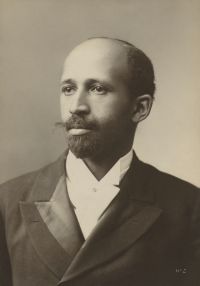
W.E.B. DuBois

W.E.B. DuBois

Summary

Portrait of W.E.B. DuBois W.E.B. DuBois The Black North: A Social Study (1901)

The excess of young people from eighteen to thirty years of age points again to large and rapid immigration. The Wilmington riot alone sent North thousands of emigrants, and as the black masses of the South awaken or as they are disturbed by violence this migration will continue and perhaps increase.
The North, therefore, and especially great cities like New York, has much more than an academic interest in the Southern negro problem. Unless the race conflict there is so adjusted as to leave the negroes a contented, industrious people, they are going to migrate here and there.
Source: Wikisource

Portrait of W.E.B. DuBois W.E.B. DuBois The Black North: A Social Study (1901)

They say either that the case of the negro is that of the replacing of a poor workman by better ones in the neutral competition of trade or that a mass of people like the American negroes ought to furnish employment for themselves without asking others for work.
There is just enough truth in such superficial statements to make them peculiarly misleading and unfair. Before the civil war the negro was certainly as efficient a workman as the raw immigrant from Ireland or Germany.
Source: Wikisource

Portrait of W.E.B. DuBois W.E.B. DuBois The Black North: A Social Study (1901)

Again, it is impossible for a group of men to maintain and employ itself while in open competition with a larger and stronger group. Only by co-operation with the industrial organization of the Nation can negroes earn a living. And this co-operation is difficult to effect. One can easily trace the struggle in a city like New York. Seventy-four per cent of the working negro population are common laborers and servants.
Source: Wikisource

Get perspective with Kwize: daily news enlightened by great literature