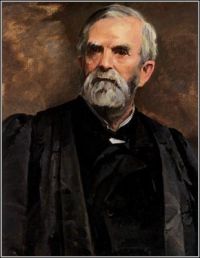
William Burnham Woods

William Burnham Woods

Summary

Portrait of William Burnham Woods William Burnham Woods Hunt v. Oliver (118 U.S. 211)…

In short, the Buffalo agreement, which the bill assails, appears to have been made with Oliver's assent, to have been to his advantage, and to have been fairly performed.
On every ground for relief alleged in the bill there is a failure of proof. This view renders it unnecessary to consider the effect as a bar to the relief sought in this case, of the decree in the suit for foreclosure brought by Hunt and Eschleman against Oliver.
Source: Wikisource

Portrait of William Burnham Woods William Burnham Woods Hunt v. Oliver (118 U.S. 211)…

Conceding, therefore, that Hunt and Eschleman allowed Cunningham to get a foothold in the firm by authorizing him to promise that the property of the firm should be protected from the Hunt and Eschleman mortgage,-and the testimony shows nothing more,-this does not prove or tend to prove that they were partners. If they had given Cunningham outright their whole interest in the mortgage, that fact would not have invested them with any rights in the property of the firm, or subjected them to its liabilities. The contention that they were partners in the firm of Cunningham, Robinson, Haines & Co.
Source: Wikisource

Portrait of William Burnham Woods William Burnham Woods Hunt v. Oliver (118 U.S. 211)…

The bill prayed that the deed and all the transfers made by Oliver to Cunningham, the Buffalo agreement, and the deed of Cunningham to Robinson, Haines, and Ranney, might be canceled as fraudulent and void; that an account might be taken of the issues and profits of said lands received by Cunningham for the benefit of himself and Hunt and Eschleman, and the mortgage held by them be charged with the amount thereof; that the plaintiff might be at liberty to redeem
Source: Wikisource

Get perspective with Kwize: daily news enlightened by great literature