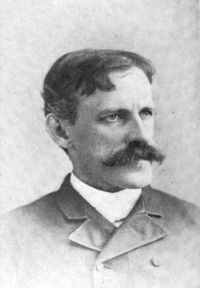
William Elliot Griffis

William Elliot Griffis

Summary

Portrait of William Elliot Griffis William Elliot Griffis Arendt van Curler (1884)

He called it "the fairest land that the eyes of man ever rested upon," but the moral beauty of his own act exceeded even that of nature. He did not succeed in ransoming or rescuing the priest, Father Jogues; but he secured a promise from the savages not to kill or further torture him. Afterwards, Van Curler assisted Jogues to escape from Albany to France, where at the imperial court at Versailles the scars of his fingers which the savages, like wild beasts, had chewed and from which they had torn out his nails, were kissed by proud lords and lovely ladies as of those of a saint.
Source: Wikisource

Portrait of William Elliot Griffis William Elliot Griffis Arendt van Curler (1884)

Craving pardon of my hearers, and of this honorable Albany Institute for presenting so fragmentary a paper, pleading shortness of notice, and press of imperative duties as my excuse, I beg leave to state that life and leisure being given, I hope to do fuller justice to a name most noble among those who laid the foundations of the greatness of the Empire State.
Source: Wikisource

Portrait of William Elliot Griffis William Elliot Griffis Arendt van Curler (1884)

Fair as the moon and terrible to the red man as an army with banners, as is her imperial majesty, the sun that supplies the glory of her prestige is the name of Van Curler - the original Mohawk Dutchman. Herein is fulfilled the wise man's prophecy, "Seest thou a man who is diligent in his business, he shall stand before kings."
While on this subject of titles, let us note further the term "Onontio" used by the Iriquois before the time of Van Curler, and down to the conquest of Canada by Wolfe, and familiar to all readers of Colonial documents or Indian eloquence.
Source: Wikisource

Get perspective with Kwize: daily news enlightened by great literature