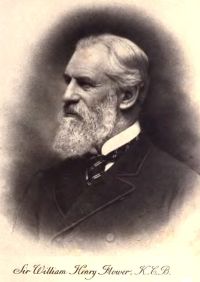
 William Henry Flower,
Quarterly Journal of the Geological Society of London
(1877)
William Henry Flower,
Quarterly Journal of the Geological Society of London
(1877)
“ The Sewalik animal was older, and the tooth more worn, which may account for the absence, or, at all events, less distinct evidence of the fine striation of the surface of the enamel, in lines converging to the apices of the cusps, which is beautifully seen in both the Crag teeth. The Sewalik specimen was first described by Cautley and Falconer, in the 'Asiatic Researches,' vol. xix. p. 193 (1836) , under the name of Ursus sivalensis; and it is certainly very closely allied to the true bears, though in its dentition somewhat less specialized than the modern representatives of the group. ”
