Summary

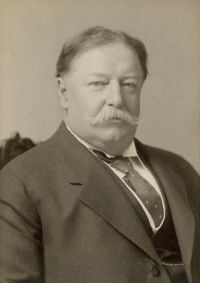
Portrait of William Howard Taft William Howard Taft Samuels v. McCurdy — Opinion of the Court

It is obvious that if men are permitted to maintain liquor in their possession, though only for their own consumption, there is danger of its becoming accessible to others. Legislation making possession unlawful is therefore within the police power of the states as reasonable mode of reducing the evils of drunkenness, as we have seen in the Crane and Barbour Cases. The only question which arises is whether for the shrunken opportunity of the possessor of liquor who acquired it before the law, to use it only for his own consumption, the state must make compensation.
Source: Wikisource

Portrait of William Howard Taft William Howard Taft Samuels v. McCurdy — Opinion of the Court

That which had the qualities of property has, by successive provisions of law in the interest of all, been losing its qualities as property. For many years, every one who has made or stored liquor has known that it was a kind of property which because of its possible vicious uses might be denied by the state the character and attributes as such, that legislation calculated to suppress its use in the interest of public health and morality was lawful and possible, and this without compensation.
Source: Wikisource

Portrait of William Howard Taft William Howard Taft Samuels v. McCurdy — Opinion of the Court

Justice Harlan, speaking for the court, said:
'As already stated, the present case must be governed by principles that do not involve the power of eminent domain, in the exercise of which property may not be taken for public use without compensation. A prohibition simply upon the use of property for purposes that are declared, by valid legislation, to be injurious to the health, morals, or safety of the community, cannot, in any just sense, be deemed a taking or an appropriation of property for the public benefit.
Source: Wikisource

Get perspective with Kwize: daily news enlightened by great literature