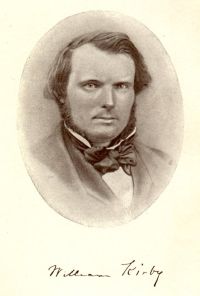
William Kirby

William Kirby

Summary

Portrait of William Kirby William Kirby The Golden Dog — Chapter XXXII (1877)

The eager persistence of Angelique, in her demand for a lettre de cachet to banish the unfortunate Caroline, had wearied and somewhat disgusted Bigot.
"I would cut the throat of any man in the world for the sake of her bright eyes," said he to himself, as she gave him a parting salute with her handkerchief; "but she must not ask me to hurt that poor foolish girl at Beaumanoir. No, by St. Picot! she is hurt enough already, and I will not have Angelique tormenting her! What merciless creatures women are to one another, Cadet!"
Source: Wikisource

Portrait of William Kirby William Kirby The Golden Dog — Chapter XXXII (1877)

Bigot, a voluptuary in every sense, craved a change of pleasure. He was never satisfied long with one, however pungent. He felt it as a relief when Angelique went off like a laughing sprite upon the arm of De Pean. "I am glad to get rid of the women sometimes, and feel like a man," he said to Cadet, who sat drinking and telling stories with hilarious laughter to two or three boon companions, and indulging in the coarsest jests and broadest scandal about the ladies at the ball, as they passed by the alcove where they were seated.
Source: Wikisource

Portrait of William Kirby William Kirby The Golden Dog — Chapter XXXII (1877)

Since you desire it,"--De Pean spoke it with bitterness,-- "Le Gardeur shall come back, but I doubt if it will be for his benefit or yours, Mademoiselle."
"What do you mean, De Pean?" asked she, abruptly, her dark eyes alight with eager curiosity, not unmingled with apprehension. "Why do you doubt it will not be for his benefit or mine? Who is to harm him?"
"Nay, he will only harm himself, Angelique. And, by St. Picot! he will have ample scope for doing it in this city. He has no other enemy but himself." De Pean felt that she was making an ox of him to draw the plough of her scheming.
Source: Wikisource

Get perspective with Kwize: daily news enlightened by great literature