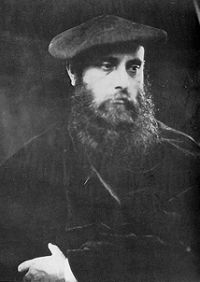
William Michael Rossetti

William Michael Rossetti

Summary

Portrait of William Michael Rossetti William Michael Rossetti 1911 Encyclopædia Britannica, Volume 17… (1911)

Mantegna then returned to Mantua, and went on with a series of works—the nine tempera-pictures, each of them 9 ft. square, of the “Triumph of Caesar”—which he had probably begun before his leaving for Rome, and which are now in Hampton Court. These superbly invented and designed compositions, gorgeous with all splendour of subject-matter and accessory, and with the classical learning and enthusiasm of one of the master-spirits of the age, have always been accounted of the first rank among Mantegna’s works.
Source: Wikisource

Portrait of William Michael Rossetti William Michael Rossetti 1911 Encyclopædia Britannica, Volume 17… (1911)

Trained as he had been to the study of marbles and the severity of the antique, and openly avowing that he considered the antique superior to nature as being more eclectic in form, he now and always affected precision of outline, dignity of idea and of figure, and he thus tended towards rigidity, and to an austere wholeness rather than gracious sensitiveness of expression.
Source: Wikisource

Portrait of William Michael Rossetti William Michael Rossetti 1911 Encyclopædia Britannica, Volume 17… (1911)

With his fellow-pupils at Padua he had been affectionate; and for two of them, Dario da Trevigi and Marco Zoppo, he retained a steady friendship. That he had a high opinion of himself was natural, for no artist of his epoch could produce more manifest vouchers of marked and progressive attainment. He became very expensive in his habits, fell at times into difficulties, and had to urge his valid claims upon the marquis’s attention. After his return to Mantua from Rome his prosperity was at its height, until the death of his wife.
Source: Wikisource

Get perspective with Kwize: daily news enlightened by great literature